Electric vehicles can cost less to fuel than comparable gasoline cars, but there is no single price to charge every EV. Your actual cost depends on the size of the battery, the electricity rate where you charge, how much energy you add, charging losses, and whether you use home or public charging.
For U.S. drivers, home charging is usually the lowest-cost option. Public DC fast charging is much quicker and especially useful on road trips, but it normally costs more than residential electricity.
The latest U.S. Energy Information Administration data available for this guide show an average residential electricity price of 18.16 cents per kilowatt-hour for January through June 2026. At that average rate, adding 60 kWh of energy costs about $10.90 before charging losses. Your state, utility plan, and time-of-use rate can make the real number higher or lower.
This guide explains how much it costs to charge an electric car at home and in public, how Level 1, Level 2, and DC fast charging compare, how to calculate cost per mile, and practical ways to reduce charging expenses.
Table of Contents
What Determines the Cost of Charging an Electric Car?
The cost to charge an EV is mainly determined by how many kilowatt-hours (kWh) you add and the price you pay for each kWh. A larger battery can cost more to fill from empty, but most drivers do not recharge from 0% to 100% every day.
Electricity rates also vary widely by state, utility provider, season, and time of day. Some utilities offer time-of-use plans with cheaper overnight rates, while public charging networks may use different pricing structures.
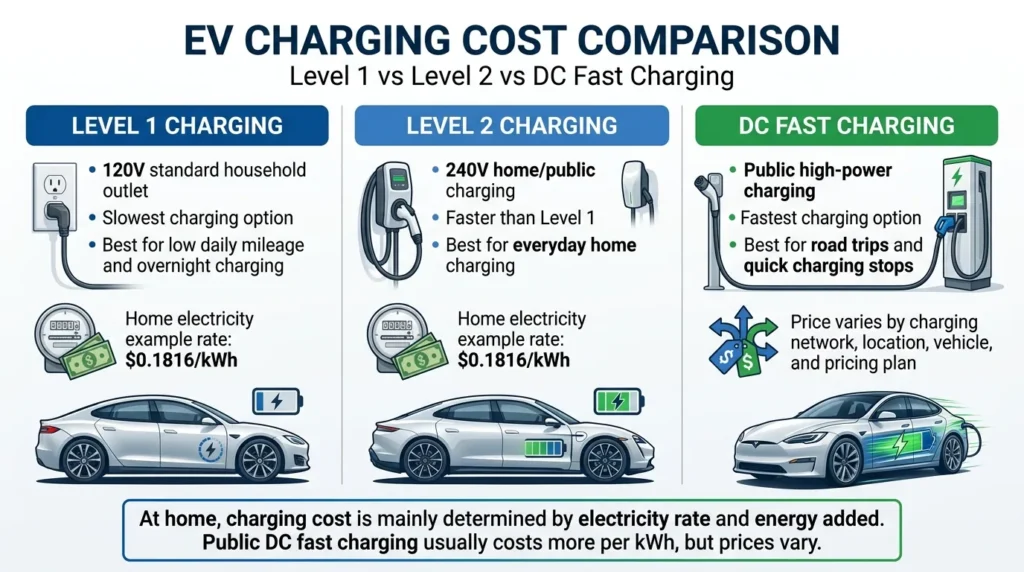
The charging location matters too. Home Level 1 and Level 2 charging normally use residential electricity. Public charging can include network, site, parking, or session costs, and DC fast charging is generally more expensive than charging at home.
Important factors include:
- Local electricity rate in dollars per kWh
- Amount of energy added to the battery
- Battery capacity
- Charging location: home, workplace, or public station
- Charging level: Level 1, Level 2, or DC fast charging
- Time-of-use pricing
- Charging losses and efficiency
- Weather and battery temperature
- Public-network pricing, session fees, or parking fees where applicable
A simple estimate is: Charging cost = energy added (kWh) × electricity price ($/kWh). For a more realistic home estimate, allow for some energy loss between the wall and the battery.
Related Guide: How Long Does It Take to Charge an Electric Car? (2026 Guide)
How Much Does It Cost to Charge an EV at Home?
Home charging is typically the most cost-effective and convenient option for EV owners who can charge where they park. You pay for the electricity through your household utility bill, just as you do for other appliances.
Using the 2026 U.S. residential year-to-date average of $0.1816 per kWh, the energy cost of adding 60 kWh is:
60 kWh × $0.1816 = about $10.90
That figure represents the electricity delivered as 60 kWh in the calculation. Real charging can require somewhat more energy from the wall because charging is not 100% efficient, so your utility-bill cost may be modestly higher.
Most drivers top up rather than charge from empty. If you add only 20 kWh after a normal day of driving, the same national-average rate would equal about $3.63 before charging losses.
Your own utility rate is more useful than the national average. Check your electric bill or utility website and use the per-kWh rate that applies when you normally charge.
| Energy Added | Cost at $0.1816/kWh* |
| 20 kWh | $3.63 |
| 40 kWh | $7.26 |
| 60 kWh | $10.90 |
| 80 kWh | $14.53 |
| 100 kWh | $18.16 |
*Illustrative electricity-only estimates using the U.S. residential average for January–June 2026. Actual rates and charging losses vary.

Level 1 Charging Cost
Level 1 charging uses a standard 120-volt household outlet. It is slow, but the electricity itself does not inherently cost more than Level 2 charging when both use the same residential rate. The main difference is charging speed, not the per-kWh price.
Level 1 can work well for drivers with short daily mileage, plug-in hybrids, or people who have many hours available to charge.
How Much Does Level 1 Charging Cost?
Use the same formula as any home charging session: energy added × your residential electricity rate. At $0.1816 per kWh, illustrative electricity costs are:
- 40 kWh added: about $7.26
- 60 kWh added: about $10.90
- 80 kWh added: about $14.53
Actual utility-bill cost can be slightly higher because of charging losses.
Advantages of Level 1 Charging
- Often requires no dedicated charging-station purchase
- Uses a standard 120-volt outlet when the circuit is suitable
- Can be enough for short daily commutes
- Convenient for overnight top-ups
Limitations of Level 1 Charging
- Slowest common EV charging option
- May not restore heavy daily energy use overnight
- Less practical for large batteries or long commutes
- Electrical outlet and circuit must be appropriate for continuous charging
Level 2 Charging Cost
Level 2 home charging generally uses a 240-volt supply and charges much faster than Level 1. For most households, the electricity price per kWh is still the residential utility rate, so Level 2 is mainly a speed and convenience upgrade rather than a cheaper source of electricity.
The U.S. Department of Energy’s Alternative Fuels Data Center notes that Level 2 equipment can involve an upfront equipment and installation cost, and electrical upgrades can increase that cost.
How Much Does Level 2 Charging Cost?
| Energy Added | Estimated Electricity Cost* |
| 40 kWh | $7.26 |
| 60 kWh | $10.90 |
| 80 kWh | $14.53 |
| 100 kWh | $18.16 |
*Using $0.1816/kWh for illustration; excludes charging losses and any charger-installation expense.
Level 2 Installation Cost
The one-time cost of home Level 2 charging is separate from the electricity used by the car. Equipment price, wiring distance, panel capacity, permits, and labor all affect installation cost. Homes that need a panel or service upgrade can cost substantially more than straightforward installations.
Before buying equipment, confirm the vehicle’s charging capability and ask a qualified electrician to evaluate the circuit and installation requirements.
Why Many EV Owners Choose Level 2 Charging
- Faster overnight charging
- Home-electricity pricing rather than typical public fast-charging pricing
- Convenient daily charging
- Better fit for higher daily mileage
- Useful balance of speed and cost
How Much Does DC Fast Charging Cost?
DC fast charging is designed for speed. It is commonly found along highway corridors and at public charging hubs, and it can add substantial driving range much faster than home AC charging.
Public fast-charging prices vary by network, location, membership status, and local rules. Pricing may be based on energy used, time, a session fee, a subscription, or a combination of charges. Because of this variation, there is no reliable nationwide flat price for one DC fast-charging session.

Example DC Fast-Charging Cost
A useful way to estimate a session is to multiply the energy you expect to add by the station’s displayed per-kWh price. For example, if a station charges $0.50 per kWh:
- 30 kWh added = $15
- 50 kWh added = $25
- 70 kWh added = $35
These are examples, not national fixed prices. Always check the station or network price before starting a session.
Is DC Fast Charging Worth the Cost?
For road trips and situations where time matters, it can be very valuable. Charging speed depends on the vehicle, charger power, battery temperature, and state of charge, and charging commonly slows as the battery becomes fuller.
For routine daily charging, home Level 1 or Level 2 charging is usually less expensive when it is available.
Advantages of DC Fast Charging
- Fastest common public charging option
- Useful for road trips and long-distance travel
- Rapid range recovery
- Available at many highway and urban charging locations
Limitations of DC Fast Charging
- Usually costs more than home charging
- Price varies by network and location
- Charging speed can taper at higher states of charge
- Vehicle compatibility and maximum charging rate affect results
EV Charging Cost vs. Gasoline Cost
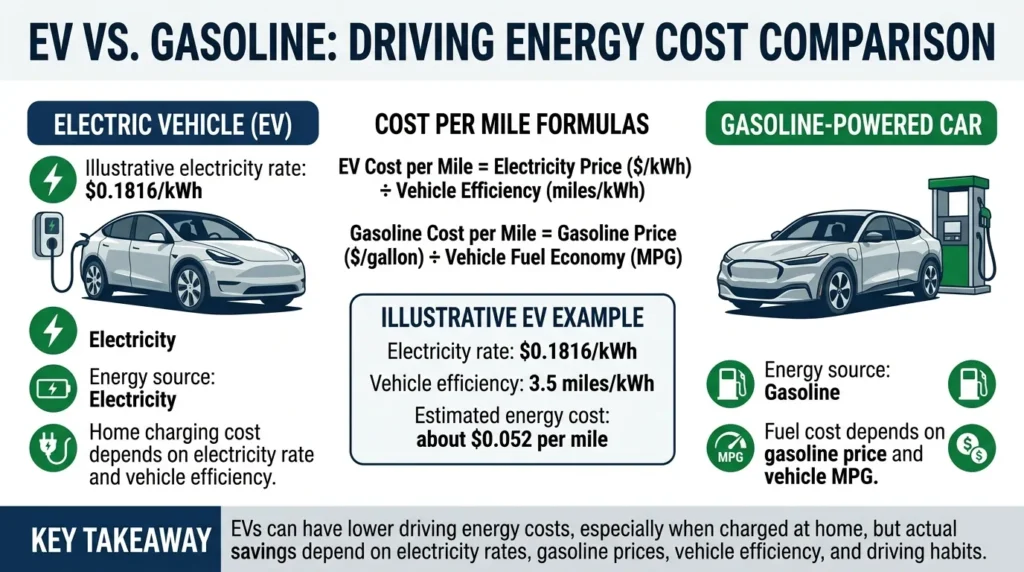
EPA notes that it is typically cheaper to charge a plug-in electric vehicle than to fill a gasoline tank, although the exact comparison depends on local electricity and gasoline prices, vehicle efficiency, and driving habits.
A fair comparison should use cost per mile rather than comparing a battery ‘fill’ with a gasoline tank, because vehicles have different ranges and efficiencies.
| Factor | Electric Vehicle | Gasoline Vehicle |
| Energy source | Electricity | Gasoline |
| Best comparison | Cost per mile | Cost per mile |
| Home refueling | Often available | Generally not available |
| Price variation | Utility rate / charging network | Fuel station / market price |
| Routine maintenance | Typically fewer powertrain service items | More engine-related service items |
For the most accurate comparison, use your EV’s kWh-per-100-miles figure, your actual electricity rate, the gasoline vehicle’s MPG, and the current local gasoline price.
How Much Does It Cost to Drive an EV Per Mile?
Cost per mile is one of the clearest ways to compare EV energy expenses. You need two numbers: the vehicle’s energy consumption and your electricity price.
If an EV uses 30 kWh per 100 miles and electricity costs $0.1816 per kWh:
30 kWh × $0.1816 = $5.45 per 100 miles
$5.45 ÷ 100 = about 5.4 cents per mile
A more efficient EV will cost less per mile at the same electricity rate, while cold weather, high speeds, towing, or aggressive driving can increase energy consumption.
Alternative Miles-per-kWh Example
If your EV averages 4 miles per kWh, the calculation is:
$0.1816 ÷ 4 = about $0.045 per mile
That is roughly $4.54 in electricity for 100 miles before accounting for charging losses.
Tips to Reduce EV Charging Costs

Charge During Off-Peak Hours
If your utility offers time-of-use pricing, charging overnight or during lower-rate periods can reduce costs. Check the exact hours and rates on your utility plan.
Use Home Charging When Practical
EPA and DOE guidance indicate that home charging is typically the most cost-effective option. Public charging is valuable for travel and drivers without home access, but fast charging generally carries a price premium.
Use DC Fast Charging Strategically
Reserve higher-priced fast charging for trips or situations where the time savings are worth the extra cost. For everyday use, home charging is usually more economical.
Look for Legitimate Free or Discounted Charging
Some workplaces, hotels, retailers, and parking facilities offer free or discounted charging. Check any parking fees, time limits, or access rules before assuming the session is free.
Follow Your Vehicle’s Charging Guidance
Battery charging recommendations differ by manufacturer and battery chemistry. Some vehicles suggest a lower daily charge limit and a higher limit before trips. Follow the owner’s manual or in-car charging guidance rather than using one percentage rule for every EV.
Keep Your Vehicle Updated
Software updates can change charging behavior, route planning, battery preconditioning, and energy-management features. Keep the vehicle software current when updates are provided by the manufacturer.
Key Tips at a Glance
- Use your actual utility rate instead of relying only on a national average.
- Multiply energy added in kWh by the applicable price per kWh.
- Charge at home when practical for lower everyday costs.
- Use time-of-use or off-peak rates when they genuinely save money.
- Check public-station pricing before starting a session.
- Compare EVs and gasoline cars using cost per mile.
- Follow the charging recommendations for your specific vehicle.
Frequently Asked Questions
How much does it cost to fully charge an electric car?
It depends on battery size and electricity price. At the January–June 2026 U.S. residential average of 18.16 cents per kWh, 60 kWh of energy costs about $10.90 and 80 kWh costs about $14.53 before charging losses. Your local rate may be much lower or higher.
Is it cheaper to charge an electric car than to buy gasoline?
Often, yes. EPA says charging a plug-in electric vehicle is typically cheaper than filling a gasoline tank, but the size of the savings depends on local energy prices and vehicle efficiency.
Does charging at home cost less than public charging?
Usually. Home charging generally uses residential electricity rates, while public networks may add higher energy prices or other fees. DC fast charging is especially likely to cost more than charging at home.
How much does DC fast charging cost?
There is no single nationwide price. Check the station’s displayed rate and multiply it by the energy you plan to add. At $0.50 per kWh, for example, adding 50 kWh would cost $25 before any additional fees.
What is the cheapest way to charge an electric vehicle?
For many drivers with home charging access, charging at home—especially on a lower off-peak rate when available—is the least expensive approach. The cheapest option for you depends on your utility plan and any workplace or public charging benefits you can legitimately use.
Does Level 2 cost more than Level 1?
Not necessarily for electricity. If both use the same residential rate, the per-kWh energy price is generally the same. Level 2 may have higher upfront equipment and installation costs, but it charges much faster.
Final Thoughts
So, how much does it cost to charge an electric car? The best answer comes from your own electricity rate and the amount of energy you add. At the 2026 U.S. residential year-to-date average used in this guide, adding 60 kWh costs about $10.90 before charging losses, but real-world prices vary significantly by location and charging method.
Home charging is usually the most economical choice for everyday driving, while public DC fast charging provides valuable speed and convenience on longer trips. Comparing cost per mile gives you a more meaningful EV-versus-gasoline comparison than simply comparing a full battery with a full fuel tank.
By checking your utility rate, using lower-cost charging periods when available, and choosing public fast charging strategically, you can keep EV energy costs predictable and make better ownership decisions.