Electric vehicles (EVs) are becoming increasingly common on American roads, but one question still concerns many current and future owners: how much does an EV battery replacement cost?
A complete EV battery replacement can cost thousands of dollars, but the actual price varies widely by vehicle, battery size, manufacturer, repair method, and warranty coverage. Out-of-warranty replacement costs commonly run into five figures, although some repairs cost much less when individual modules or components can be repaired instead of replacing the entire battery pack.
The good news is that complete battery replacements due to failure are uncommon in modern EVs. Most high-voltage batteries are designed for long service lives, and many manufacturers provide lengthy battery warranties.
In this guide, you’ll learn how much EV battery replacement can cost in the United States, what affects the final price, when replacement may be necessary, how warranties work, and what you can do to reduce the risk of an expensive repair.
Table of Contents
What Is an EV Battery?
An EV battery is a large high-voltage battery pack that stores electrical energy and powers the vehicle’s electric motor.
Unlike the small 12-volt battery found in conventional cars, an EV traction battery contains many individual battery cells organized into modules or other pack structures. The battery pack also includes electronics, sensors, cooling components, and a battery management system (BMS).
The BMS monitors important factors such as:
- Battery temperature
- Charging and discharging
- Cell voltage
- Battery health
- Safety and performance
Most modern all-electric vehicles use lithium-ion batteries, although the exact battery chemistry varies between manufacturers and models.
Battery capacity is measured in kilowatt-hours (kWh). In general, larger batteries store more energy and provide greater driving range, but they can also be more expensive to repair or replace.

How Much Does an EV Battery Replacement Cost?
So, how much does an EV battery replacement cost?
There is no single price that applies to every electric vehicle. Real-world out-of-warranty replacement costs can range from roughly $5,000 to $16,000 in many cases, according to published EV battery replacement research, while some large, luxury, uncommon, or dealer-installed battery packs can cost considerably more.
The final bill depends on several factors, including:
- Battery capacity
- Vehicle make and model
- Battery chemistry and design
- New versus remanufactured battery
- Full-pack versus component or module repair
- Labor rates
- Parts availability
- Warranty coverage
Because manufacturers generally do not publish one universal replacement price for each EV battery, owners should treat online cost figures as estimates rather than guaranteed quotes.
The most accurate price will come from a manufacturer-authorized service center or qualified EV repair facility after the battery has been diagnosed.
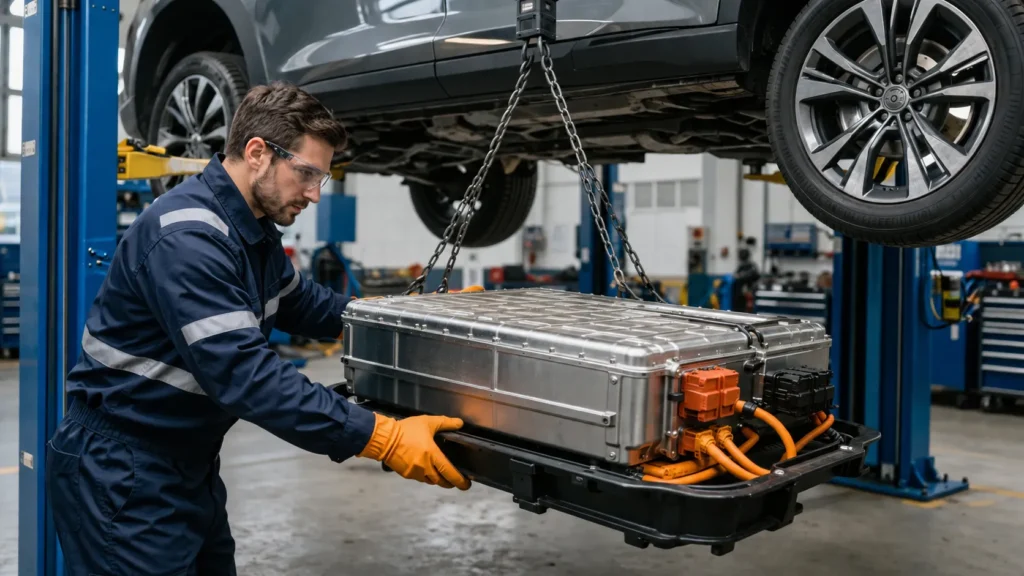
Typical EV Battery Replacement Cost
A useful general guide is:
| Repair Situation | Possible Cost Level |
| Minor battery-related repair | Lowest |
| Module or component repair, when supported | Lower than full-pack replacement |
| Remanufactured or refurbished battery | Often lower than a new OEM pack |
| New complete battery pack | Usually the most expensive |
| Large or luxury EV battery | Can be significantly more expensive |
The important point is that a battery-related problem does not automatically mean the entire battery pack must be replaced.
Some faults may involve individual modules, electrical components, cooling-system components, sensors, software, or other serviceable parts.
Battery Cost vs. Labor Cost
The battery pack itself usually represents the largest part of a complete replacement bill.
Additional expenses can include:
- Diagnostic testing
- Battery removal and installation
- Specialized high-voltage labor
- Software programming
- Battery balancing or calibration
- Coolant or related service items
- Transportation or shipping
- Recycling or handling of the old battery
EV batteries are heavy, high-voltage components and should only be serviced by technicians properly trained to work on electric vehicles.
Quick Tip: Before approving a complete battery replacement, ask whether the problem can be repaired at the module or component level. Repairability varies significantly between EV models.
What Affects EV Battery Replacement Cost?
Two EV owners can face very different repair bills even when their vehicles appear similar.
Here are the biggest factors affecting electric car battery replacement cost.

Battery Size
Battery capacity is one of the most important cost factors.
A smaller EV may use a relatively modest battery pack, while a long-range electric SUV or performance vehicle may use a much larger pack.
Larger batteries require more cells and materials, so they can be more expensive to replace.
However, battery size alone does not determine the final price. Pack design, manufacturer pricing, labor, availability, and repairability also matter.
Battery Chemistry
Different EVs use different lithium-ion battery chemistries.
Common examples include:
- Lithium Iron Phosphate (LFP)
- Nickel Manganese Cobalt (NMC)
- Nickel Cobalt Aluminum (NCA)
These chemistries differ in cost, energy density, durability, thermal characteristics, and manufacturing requirements.
Battery chemistry can therefore influence both vehicle cost and long-term repair economics.
Vehicle Brand and Model
Replacement prices can vary substantially between manufacturers and even between different models from the same brand.
Important factors include:
- OEM battery pricing
- Battery-pack design
- Availability of replacement packs
- Whether module-level repairs are supported
- Software requirements
- Dealer labor rates
- Availability of remanufactured packs
Older or low-production EVs may sometimes face additional parts-availability challenges.
Labor Costs
Replacing or repairing a high-voltage EV battery requires specialized knowledge, tools, and safety procedures.
Labor costs may depend on:
- Vehicle design
- Battery accessibility
- Required diagnostic work
- Local hourly labor rates
- Software calibration
- Dealer versus independent EV specialist
A battery mounted beneath the vehicle may also require specialized lifting equipment for safe removal.
Location
Your location can affect EV battery repair costs through:
- Regional labor rates
- Taxes and fees
- Availability of qualified EV technicians
- Shipping expenses
- Dealer competition
- Availability of replacement batteries
Owners in areas with fewer EV service facilities may have fewer repair options.
Battery Availability
Parts availability can also affect the final cost and repair time.
Replacement packs for popular current models may be easier to source than batteries for older or less common EVs.
Supply shortages, discontinued parts, shipping costs, and manufacturer inventory can all influence the final bill.
How Often Do EV Batteries Need Replacement?
Complete EV battery replacements are much less common than many potential buyers assume.
Modern EV batteries are engineered for long-term use, and battery failure rates have improved considerably as battery chemistry, thermal management, manufacturing, and battery-management software have advanced.
U.S. Department of Energy data based on a large study of plug-in vehicles found that battery replacements caused by failure were rare, particularly among newer model years.
That does not mean an EV battery will never degrade. Lithium-ion batteries gradually lose usable capacity as they age.
However, battery degradation and battery failure are not the same thing.
A battery that has lost some range may still provide years of useful service.
For a detailed explanation of battery longevity, read our How Long Do Electric Car Batteries Last? (2026 Guide).
How Long Do EV Batteries Last?
EV battery life depends on battery chemistry, climate, charging habits, mileage, thermal management, and vehicle design.
The U.S. Department of Energy’s Alternative Fuels Data Center notes that predictive modeling suggests today’s EV batteries may last roughly 12 to 15 years in moderate climates, with shorter expected life under more extreme climate conditions.

Actual battery life can vary considerably.
Factors that may affect long-term battery health include:
- Extreme heat
- Charging patterns
- Battery chemistry
- Vehicle thermal management
- Driving conditions
- Long-term storage habits
Modern EVs use sophisticated battery-management and temperature-control systems to help protect the battery.
For everyday ownership, the best approach is to follow the charging and battery-care recommendations provided by your vehicle manufacturer.
Can an EV Battery Be Replaced?
Yes. A high-voltage EV battery can be repaired or replaced when necessary.
The appropriate repair depends on the vehicle design and the condition of the battery.
There are three main possibilities.
1. Complete Battery Pack Replacement
A complete battery replacement involves removing the existing high-voltage battery and installing another battery pack.
This may be necessary when:
- The pack has extensive internal damage
- Multiple battery components have failed
- The manufacturer specifies complete replacement
- A warranty repair requires pack replacement
- Repairing the existing pack is not economically practical
A complete new battery pack is generally the most expensive option.
2. Module or Component Repair
Some EV batteries can be repaired without replacing the complete pack.
Depending on the design, technicians may be able to replace failed modules or other serviceable components.
Potential advantages include:
- Lower repair cost
- Less material waste
- Retaining usable parts of the original battery
- Potentially shorter repair time
However, not every battery pack is designed or approved for module-level repair.
Always confirm the repair procedure recommended for your specific vehicle.

3. Refurbished or Remanufactured Battery
For some older EVs, refurbished or remanufactured battery packs may be available.
These can sometimes cost less than purchasing a new OEM battery.
Before choosing this option, check:
- Remaining battery capacity
- Battery health report
- Warranty coverage
- Supplier reputation
- Installer qualifications
- Compatibility with your exact vehicle
A cheaper battery is not necessarily better value if its remaining usable capacity is poor or warranty protection is limited.
Signs Your EV Battery May Need Inspection
EV batteries do not always fail suddenly.
Possible warning signs include:
- Significant unexplained loss of driving range
- Battery warning lights
- Unexpected changes in battery percentage
- Charging problems
- Reduced vehicle performance
- Repeated battery-related error messages
- Vehicle entering reduced-power mode
- Diagnostic reports showing abnormal battery condition
These symptoms do not automatically mean the battery needs replacement.
Charging equipment, software, sensors, cooling systems, individual battery components, and other electrical problems can produce similar symptoms.
A professional battery diagnostic test is the best way to determine the actual cause.
When Should You Schedule an Inspection?
Consider having the battery inspected if:
- Driving range drops unusually quickly.
- Battery-related warning messages repeatedly appear.
- Charging behavior changes without an obvious explanation.
- The battery pack may have been damaged in a collision.
- You are considering buying a used EV and want to verify battery health.
For a used EV, battery condition can be one of the most important factors affecting long-term ownership value.
EV Battery Warranty
Battery warranty coverage can make a major difference in the amount an owner pays for an EV battery repair.
Many EV manufacturers offer battery warranties of around 8 years or 100,000 miles, although the exact coverage varies by manufacturer, model, model year, state, and warranty terms.
Some warranties cover defects or battery failure, while others may also include capacity-retention provisions if usable battery capacity falls below a specified threshold.
Never assume that every EV warranty provides identical coverage.
Before paying for a battery repair, check the warranty documentation for your specific vehicle.
What May Be Covered?
Depending on the manufacturer, coverage may include:
- Manufacturing defects
- Unexpected battery failure
- Covered battery components
- Certain battery repairs
- Battery replacement when warranty conditions are met
- Excessive capacity loss when specifically included in the warranty
What May Not Be Covered?
Warranty exclusions can include:
- Collision damage
- Improper repairs
- Unauthorized modifications
- Misuse
- Certain environmental or external damage
- Normal degradation that remains above the warranty threshold
Exact exclusions differ between manufacturers.
If you are purchasing a used EV, also verify whether the remaining battery warranty transfers to the next owner.
How to Extend EV Battery Life
Modern EV batteries require relatively little routine maintenance, but good ownership habits can help protect long-term battery health.
Follow Manufacturer Charging Recommendations
Different battery chemistries and vehicles may have different charging recommendations.
Some manufacturers recommend limiting everyday charging to a certain percentage, while others allow or recommend regular 100% charging for specific battery types.
Therefore, follow the instructions for your particular EV rather than applying one charging rule to every vehicle.
Use DC Fast Charging When Appropriate
DC fast charging is extremely useful on road trips and when rapid charging is necessary.
Modern EVs are designed to use fast chargers, but frequent high-power charging can contribute to additional battery stress under some conditions.
For routine home charging, Level 2 charging is often the most convenient option.
Read our How Long Does It Take to Charge an Electric Car? (2026 Guide) for a complete explanation of Level 1, Level 2, and DC fast charging.
Protect the Battery From Extreme Heat
High temperatures can accelerate lithium-ion battery degradation.
Modern EVs use thermal-management systems to control battery temperature, but parking in shade or a covered area during extreme heat can still be helpful when practical.
Keep Software Updated
EV manufacturers frequently use software to manage charging, thermal control, battery performance, and efficiency.
Install manufacturer-recommended software updates when available.
Avoid Long-Term Storage at Extreme Charge Levels
If an EV will remain unused for an extended period, follow the manufacturer’s recommended storage state of charge.
Avoid leaving the battery completely discharged for long periods.
How to Reduce EV Battery Replacement Cost
If your EV develops a battery problem, several steps may help reduce your out-of-pocket expense.
Check the Warranty First
Before authorizing an expensive repair, confirm whether the battery or affected component is still covered.
This should be your first step.
Get a Battery Health Report
A diagnostic report can help determine whether the problem involves:
- Overall battery degradation
- Individual cells or modules
- Cooling components
- Electronics
- Software
- Another vehicle system
Do not approve a complete battery replacement based only on reduced range.
Ask Whether the Battery Can Be Repaired
Depending on the vehicle, repairing a module or component may cost substantially less than replacing the complete battery pack.
Compare Qualified Repair Options
If the vehicle is outside warranty, compare estimates from properly qualified EV repair facilities when possible.
Ask exactly what the estimate includes.
Consider Remanufactured Options for Older EVs
A reputable remanufactured battery may make financial sense for an older EV when a new OEM battery would cost too much relative to the vehicle’s value.
Compare warranty coverage, battery health, expected remaining life, and total installed cost before making a decision.
Is EV Battery Replacement Worth It?
Whether replacing an EV battery makes financial sense depends on the value and condition of the vehicle.
Consider:
- Current vehicle value
- Battery replacement cost
- Remaining battery warranty
- Overall vehicle condition
- Expected years of future ownership
- Availability of refurbished or repaired battery options
- Cost of replacing the vehicle instead
For example, spending $12,000 on a battery for a vehicle worth $10,000 may be difficult to justify.
On the other hand, replacing a battery in a newer EV that is otherwise in excellent condition may extend the vehicle’s useful life for many years.
The decision should be based on the total economics of the vehicle, not the battery price alone.
Frequently Asked Questions
How much does an EV battery replacement cost in the United States?
Out-of-warranty EV battery replacement can cost thousands of dollars, with published real-world estimates commonly falling around $5,000 to $16,000 for many replacements. However, some large, luxury, rare, or dealer-installed battery packs can cost considerably more. The actual price depends on the vehicle, battery size, repair method, labor, and parts availability.
Do EV batteries need to be replaced frequently?
No. Complete battery replacement due to failure is uncommon in modern EVs. Batteries gradually degrade over time, but some capacity loss does not necessarily mean the battery requires replacement.
How long do EV batteries last?
Battery life varies by vehicle, climate, battery chemistry, charging behavior, and usage. DOE-supported modeling cited by the Alternative Fuels Data Center estimates approximately 12 to 15 years in moderate climates, with shorter expected life in extreme climates.
Can an EV battery be repaired instead of replaced?
Sometimes. Depending on the vehicle’s battery design and manufacturer repair procedures, technicians may be able to repair or replace individual modules or components rather than replacing the entire pack.
Are EV batteries covered by warranty?
Most manufacturers provide lengthy EV battery warranties, commonly around 8 years or 100,000 miles, but terms vary by manufacturer, model, model year, and location. Always check the specific warranty documentation for your vehicle.
Does insurance cover EV battery replacement?
Auto insurance may cover battery damage resulting from an insured event such as a collision, depending on the policy. Normal age-related degradation and wear are generally different from accidental damage and are not normally treated as standard collision claims.
Check your policy or contact your insurer for specific coverage details.
What are the signs of an EV battery problem?
Possible signs include unusual range loss, battery warning messages, charging problems, unexpected changes in state of charge, and reduced vehicle performance. These symptoms require diagnosis because they do not necessarily mean the complete battery needs replacement.
Can a refurbished EV battery save money?
Potentially. Remanufactured or refurbished batteries can cost less than new OEM packs, particularly for older EVs. Verify remaining capacity, warranty coverage, compatibility, supplier reputation, and installer qualifications before purchasing.
Does frequent DC fast charging damage an EV battery?
Modern EVs are designed to use DC fast charging, and occasional fast charging is normal. Battery aging depends on multiple factors, including temperature, battery chemistry, charging patterns, and thermal management. Follow the manufacturer’s charging recommendations for your particular vehicle.
Is replacing an EV battery worth it?
It can be. Compare the installed battery cost with the vehicle’s current value, condition, remaining useful life, and the cost of replacing the vehicle. For some newer EVs, battery replacement can be financially reasonable; for an older low-value vehicle, it may not be.
Conclusion
So, how much does an EV battery replacement cost?
There is no universal price, but an out-of-warranty replacement can easily cost several thousand dollars, with published estimates commonly placing many replacements around $5,000 to $16,000 and some vehicles costing substantially more.
The headline replacement price, however, does not tell the whole story.
Complete battery failures are uncommon in modern EVs, many manufacturers provide lengthy battery warranties, and some battery problems can be repaired without replacing the entire pack.
If your EV develops a battery problem, start with professional diagnostics and warranty verification before approving a complete replacement.
For potential EV buyers, battery replacement cost should be considered alongside battery longevity, warranty coverage, charging costs, maintenance, and overall vehicle value.