Electric vehicle batteries are designed for long service life, but they do not stay at their original capacity forever. As an EV ages, its battery normally loses capacity gradually rather than suddenly failing.
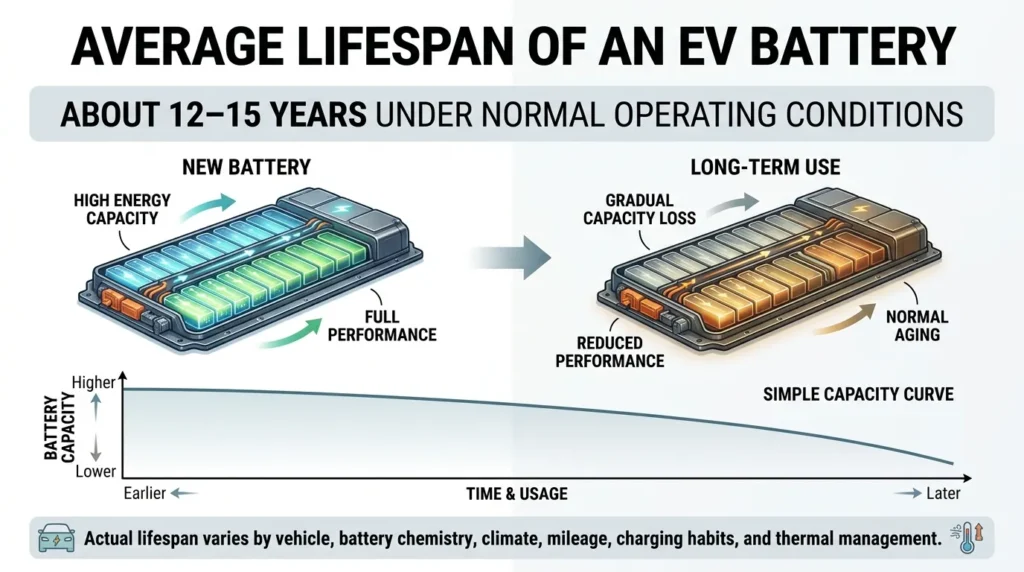
For U.S. drivers, a useful benchmark is that many modern EV batteries are expected to last roughly 12 to 15 years under normal operating conditions, while actual life can be shorter or longer depending on battery chemistry, climate, charging habits, mileage, thermal management, and the vehicle itself.
Battery durability has also improved significantly. The U.S. Environmental Protection Agency notes that battery replacements due to failure are uncommon, especially in newer model years. That does not mean degradation never happens; it means gradual capacity loss is usually a more realistic concern than sudden battery failure.
This guide explains how long electric car batteries last, what battery degradation means, which habits can affect battery health, how warranties work, and what signs may indicate an aging battery.
Table of Contents
Average Lifespan of an Electric Car Battery
There is no single expiration date for an EV battery. Battery life varies by vehicle, chemistry, climate, mileage, charging behavior, and how effectively the vehicle controls battery temperature.
The U.S. Department of Energy’s Alternative Fuels Data Center has cited an expected battery lifetime of about 12 to 15 years under normal operating conditions and moderate climates. Some batteries can remain useful longer, while harsh conditions or unusually demanding use can shorten useful life.
Battery failure is also relatively uncommon in newer EVs. The EPA reports that, in a large study of plug-in vehicles through model year 2023, battery replacements due to failure were rare outside major recalls. See the EPA’s Electric Vehicle Myths page.
An aging battery normally does not stop working at a specific year or mileage. Instead, it gradually loses usable capacity. A vehicle that once delivered 300 miles of range may eventually provide less range under comparable conditions as the battery ages.
Important: Battery age and mileage alone cannot tell you exactly how much life remains. Battery state of health, charging history, temperature exposure, and manufacturer diagnostics provide better context.
What Affects EV Battery Life?
EV battery longevity is influenced by a combination of battery design, operating conditions, and driver behavior. Some factors are built into the vehicle, while others can be managed by the owner.
- Battery chemistry and pack design
- Calendar age and total mileage
- Charge and discharge cycles
- Battery temperature and thermal management
- How often the battery stays at very high or very low state of charge
- Frequency and conditions of DC fast charging
- Driving conditions and energy demand
- Software and battery-management updates
Modern battery management systems protect the pack by controlling temperature, charging power, and usable capacity. These systems are one reason newer EV batteries generally age more predictably than early-generation packs.
Battery Chemistry
Most EVs use lithium-ion battery packs, but lithium-ion is a broad category. Different chemistries have different strengths. Nickel-rich chemistries can provide high energy density, while lithium iron phosphate (LFP) batteries are known for strong cycle life and thermal stability.
Charging guidance can differ by chemistry and manufacturer. For example, some LFP-equipped vehicles may recommend regular charging practices that differ from those used for other lithium-ion packs. Always follow the charging limit recommended in your vehicle’s owner manual or charging settings.
Charging Cycles
A battery cycle represents the equivalent of using and recharging 100% of the battery’s capacity, even if that happens through several partial charges. Batteries gradually wear as cycles accumulate, but normal partial charging does not mean every plug-in event equals one full cycle.
For most owners, it is more useful to follow manufacturer charging guidance than to count charging sessions.
How Battery Degradation Works
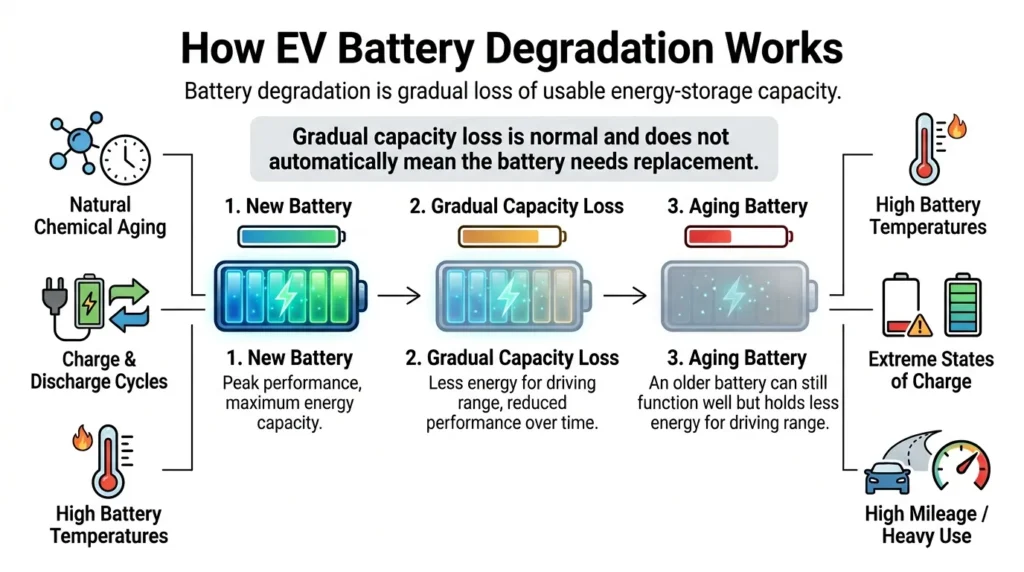
Battery degradation is the gradual loss of usable energy-storage capacity as a battery ages. It is normal for rechargeable lithium-ion batteries and usually happens over years rather than overnight.
As usable capacity declines, the most noticeable effect is reduced driving range. Degradation can also influence charging behavior and performance, although the vehicle’s battery management system continuously adjusts operation to protect the pack.
The rate of degradation is not identical for every EV. Temperature, battery chemistry, time spent at extreme states of charge, charging power, mileage, and pack design can all matter.
What Causes Battery Degradation?
- Natural chemical aging over time
- Repeated charge and discharge cycles
- Prolonged exposure to high battery temperatures
- Long periods at very high or very low state of charge, depending on battery chemistry
- Heavy use and high accumulated mileage
- Charging and driving conditions that create additional battery heat
These factors do not mean normal EV use is harmful. Battery packs are engineered with protective buffers, cooling systems, and software controls to reduce unnecessary stress.
Is Battery Degradation Normal?
Yes. Some capacity loss is expected as an EV battery ages. Gradual range reduction does not automatically mean the battery needs replacement. Replacement is more likely to be considered when capacity loss becomes severe, a fault develops, or the battery no longer meets the owner’s practical needs.
Charging Habits That Can Support Battery Health
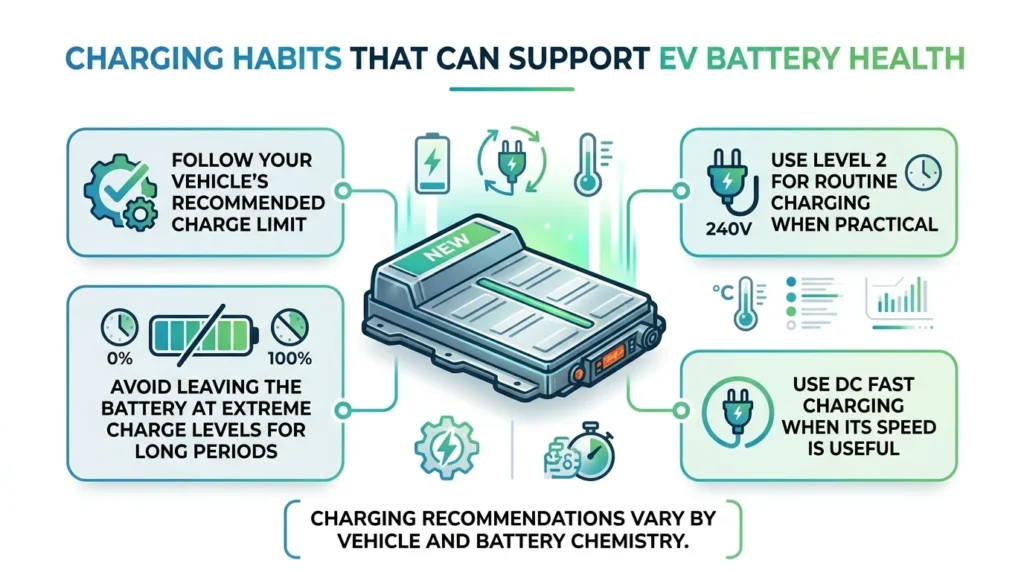
Good charging habits can reduce avoidable battery stress, but there is no universal charging rule for every EV. The manufacturer’s guidance for your specific battery should take priority.
Avoid Leaving the Battery at Very High Charge for Long Periods
For many non-LFP lithium-ion EVs, routinely leaving the battery at 100% for long periods can increase battery stress. If you need maximum range for a trip, charging to 100% shortly before departure is generally more sensible than leaving the vehicle fully charged for days.
Many owners use a lower daily charge limit when their vehicle manufacturer recommends it. However, the ideal limit varies by model and battery chemistry, so do not treat a fixed 20%–80% rule as universal.
Use DC Fast Charging When It Makes Sense
DC fast charging is designed for convenience, especially on road trips. Modern EVs actively manage fast-charging power and battery temperature, so occasional fast charging is normal use.
For routine charging, home or workplace Level 2 charging is often more convenient and can reduce repeated high-power charging. Long-term battery impact depends on the vehicle, battery temperature, charging pattern, and thermal management rather than on the charger label alone.
Avoid Repeatedly Running the Battery Extremely Low
Regularly arriving near 0% can reduce flexibility and may place additional stress on some battery chemistries. Recharging before the battery becomes critically low is a practical habit for both battery care and everyday convenience.
How Weather and Temperature Affect Battery Life
Temperature affects both short-term EV performance and long-term battery aging. Modern EVs use thermal-management systems to keep the battery within a safer operating range, but extreme conditions can still matter.
Hot Weather
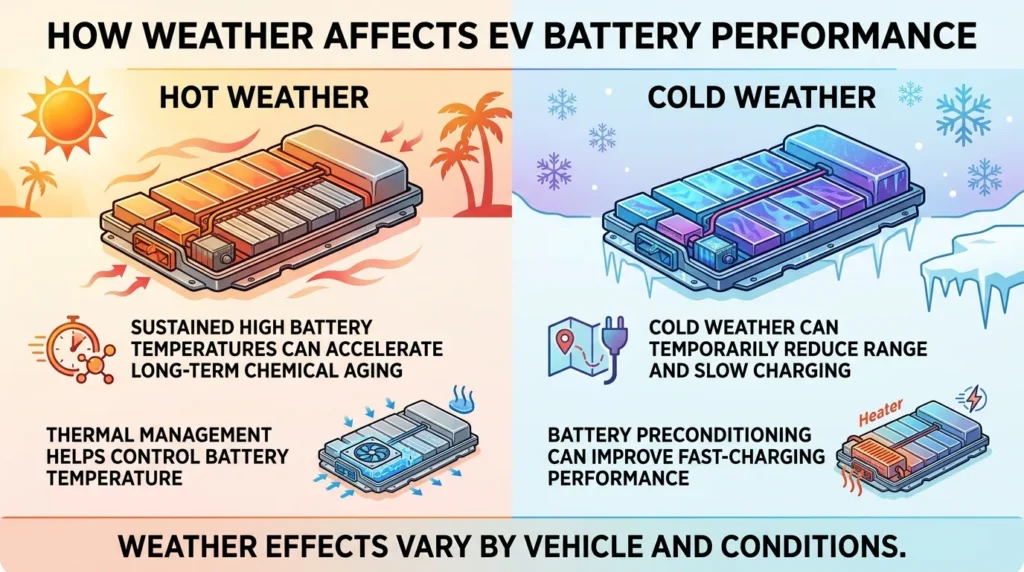
Sustained high battery temperatures can accelerate chemical aging. Parking in shade or a garage when practical, keeping the vehicle plugged in when the manufacturer recommends it, and allowing the thermal-management system to operate can help in very hot climates.
Cold Weather
Cold weather commonly reduces range and slows charging temporarily. Cabin heating also increases energy use. These effects are usually performance-related rather than permanent battery damage.
Many EVs offer battery preconditioning before DC fast charging. Preconditioning can warm the battery toward a more suitable charging temperature and improve fast-charging performance.
EV Battery Warranty Explained
Battery warranties provide important protection, but warranty length and capacity-loss terms vary by manufacturer and model.
In the United States, an 8-year/100,000-mile battery warranty is common. Some manufacturers or jurisdictions provide different or longer coverage. The U.S. Department of Energy’s Alternative Fuels Data Center recommends checking the manufacturer’s specific battery warranty.
A battery warranty may cover defects or failures, and some warranties include a capacity-retention threshold. Normal degradation that remains above the manufacturer’s threshold may not qualify for replacement.
Before buying a new or used EV, check the exact warranty duration, mileage limit, capacity-retention provision, exclusions, transferability, and diagnostic requirements.
What Does an EV Battery Warranty Typically Cover?
- Covered manufacturing defects
- Covered battery or component failures
- Capacity loss beyond a stated threshold, when the warranty includes such a provision
- Repair or replacement when the failure meets the manufacturer’s warranty terms
Accidental damage, misuse, unauthorized modifications, and normal aging outside the stated warranty conditions may be excluded. Terms differ, so the warranty booklet for the specific vehicle is the controlling source.
Signs Your EV Battery Is Aging
Battery aging usually develops gradually. A change in range by itself does not prove the battery is failing because weather, speed, tires, HVAC use, terrain, and driving style can also affect efficiency.
Reduced Driving Range
A consistent reduction in range under similar conditions can be a sign of capacity loss. Compare similar seasons, routes, speeds, and charging levels before drawing conclusions.
Changes in Charging Behavior
Charging speed naturally varies with battery temperature, state of charge, charger capability, and the vehicle’s charging curve. If charging becomes consistently abnormal under comparable conditions, vehicle diagnostics may help determine whether battery aging or another issue is involved.
Lower Reported Battery Health
Some vehicles or service tools provide battery state-of-health information. A gradual decline can be normal. A sudden change or a value below a warranty threshold deserves professional evaluation.
Warning Messages or Battery Alerts
Battery fault warnings, charging-system alerts, or a sudden major loss of range should be investigated promptly. An authorized or EV-qualified service center can determine whether the problem is the traction battery, charging hardware, software, or another component.
Tips to Make Your EV Battery Last Longer
You cannot stop battery aging, but you can avoid unnecessary stress and follow the operating strategy designed for your vehicle.

- Follow the manufacturer’s recommended daily charge limit for your battery chemistry.
- Avoid leaving the battery at an extreme state of charge for long periods when the manufacturer advises against it.
- Use Level 2 charging for routine home or workplace charging when practical.
- Use DC fast charging when its speed is useful, especially on trips.
- Use battery preconditioning before fast charging when your EV supports it.
- Reduce prolonged exposure to extreme heat when practical.
- Keep vehicle and battery-management software updated.
- Investigate battery warnings or sudden range changes rather than assuming they are normal degradation.
Quick Tip: The best battery-care rule is not a universal percentage. Follow the charging guidance built into your specific EV, because recommended limits can differ by battery chemistry and model.
Frequently Asked Questions
How long do electric car batteries usually last?
A commonly cited expectation is about 12 to 15 years under normal operating conditions and moderate climates, but actual battery life varies. Some packs may remain useful longer, while severe operating conditions can shorten useful life.
Do electric car batteries lose capacity over time?
Yes. Gradual capacity loss is normal for lithium-ion batteries. The rate depends on battery chemistry, temperature, age, mileage, charging behavior, and pack design.
Does frequent fast charging reduce battery life?
DC fast charging is normal and useful, especially for travel. Repeated high-power charging under stressful battery-temperature conditions can contribute to wear, but modern EVs actively manage charging power and temperature. The real effect varies by vehicle and usage pattern.
Can an electric car battery last the life of the vehicle?
It can. The EPA notes that drivetrain batteries are designed for long service life and that replacements due to failure are uncommon, particularly among newer EVs. Whether a specific battery lasts the vehicle’s entire useful life depends on the model, use, climate, and what level of remaining capacity the owner considers acceptable.
Should I always keep my EV between 20% and 80%?
No universal percentage applies to every EV. A moderate daily charge window is common advice for many lithium-ion batteries, but some vehicles—especially those using different chemistries such as LFP—may have different manufacturer recommendations. Follow your vehicle’s charging guidance.
When should an EV battery be inspected?
Consider professional inspection if you see battery or charging warnings, a sudden unexplained loss of range, repeated charging faults, or battery-health readings that appear abnormal. Gradual range changes alone should first be compared against weather and driving conditions.
Final Thoughts
So, how long do electric car batteries last? For many modern EVs, the answer is long enough to cover a substantial portion of the vehicle’s useful life. A commonly cited expectation is roughly 12 to 15 years under normal conditions, while actual longevity depends on the battery, vehicle, climate, mileage, and charging behavior.
The more important point is that EV batteries normally age gradually. Capacity loss is expected, but sudden battery replacement due to failure is uncommon in newer vehicles. Smart charging, sensible temperature management, software updates, and following the manufacturer’s recommendations can help preserve useful range over time.
Battery warranties also provide meaningful protection, with 8 years/100,000 miles being a common U.S. benchmark. Always check the exact terms for the vehicle you own or plan to buy.
Related Guides
- How Much Does an EV Battery Replacement Cost? (2026 Complete Guide)
- How Long Does It Take to Charge an Electric Car? (2026 Guide)
- How Much Does It Cost to Charge an Electric Car? (2026 Guide)
- Are Electric Cars Worth It? Complete 2026 Buyer’s Guide
- EV vs Hybrid: Which Should You Buy? (2026 Comparison Guide)