Electric vehicles (EVs) are now a mainstream option in the United States, but that does not mean an EV is automatically the best choice for every driver. The real question is whether an electric car fits your driving habits, budget, charging access, and ownership plans.
For many households, an EV can reduce energy and routine maintenance costs while providing quiet, responsive performance. For others, a higher purchase price, limited home charging, frequent long-distance travel, towing needs, or local charging conditions can make a hybrid or gasoline vehicle more practical.
Modern EVs produce no tailpipe emissions, and the U.S. Environmental Protection Agency says their lifetime greenhouse-gas emissions are typically lower than those of comparable gasoline vehicles, even after accounting for battery manufacturing. Battery failure in newer EVs is also uncommon, although gradual capacity loss over time is normal.
This guide explains the main benefits and drawbacks of EV ownership, compares EVs with gasoline cars, and helps you decide whether buying an electric car makes sense for your lifestyle in 2026.
Table of Contents
Why More Americans Consider Electric Cars
EVs have become practical for a wider range of drivers as vehicle choice, driving range, home charging equipment, and public fast-charging coverage have improved. At the same time, the best ownership experience still depends heavily on where and how you charge.
- Home charging can make daily driving simple and convenient.
- Electric motors provide smooth, quiet acceleration.
- EVs avoid oil changes and many engine-related maintenance items.
- Electricity can cost less per mile than gasoline, especially with home charging.
- EVs have zero tailpipe emissions.
- Many current models provide enough range for typical commuting and local travel.
Benefits of Owning an Electric Car
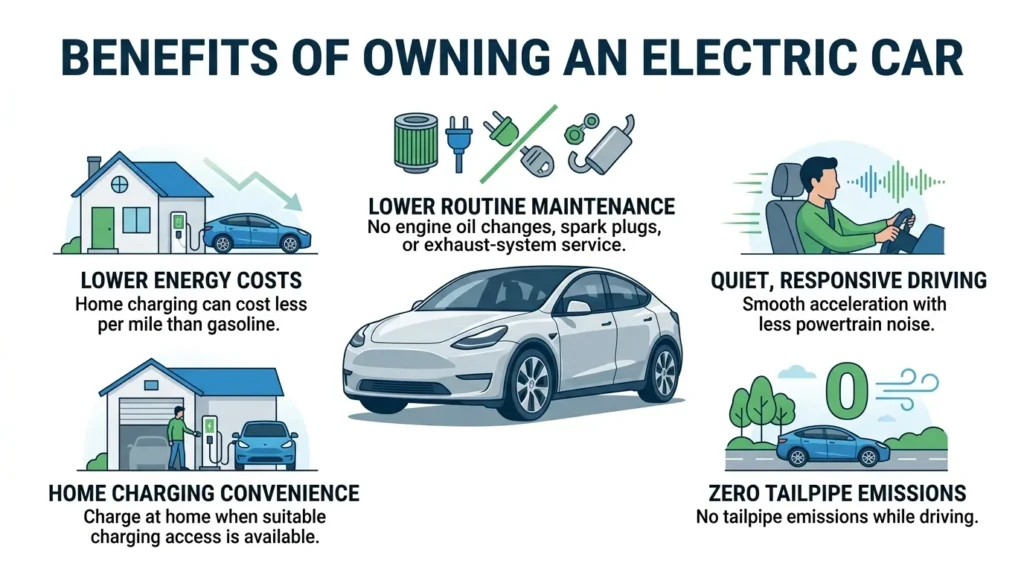
The strongest case for an EV usually comes from lower day-to-day operating costs, convenient home charging, simpler routine maintenance, and the driving experience.
Lower Energy Cost per Mile
Charging at home is often less expensive per mile than buying gasoline, although the size of the advantage depends on local electricity rates, gasoline prices, vehicle efficiency, and how often you use higher-priced public fast charging.
For a detailed cost breakdown, see our How Much Does It Cost to Charge an Electric Car? (2026 Guide).
Lower Routine Maintenance
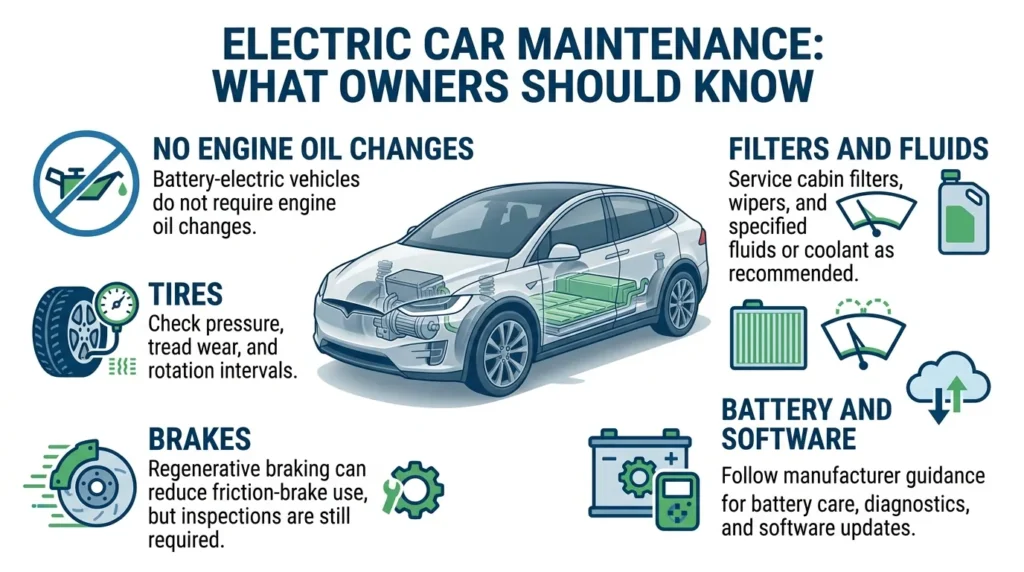
Battery-electric vehicles do not need engine oil changes, spark plugs, timing belts, or exhaust-system service. They still require tires, wipers, cabin filters, brake inspections, fluids or coolant where specified, and other manufacturer-recommended service.
Regenerative braking can reduce use of the friction brakes, but brake condition still needs inspection and tires can wear quickly on some EVs because of vehicle weight and strong torque.
Quiet, Responsive Driving
Electric motors deliver torque quickly and operate with much less powertrain noise than an internal-combustion engine. Many drivers value the smooth acceleration and quiet cabin, especially in stop-and-go traffic.
Convenient Home Charging
For drivers who can charge at home, plugging in overnight can replace many routine trips to a gas station. A Level 2 home charger is not mandatory for every driver, but it can add range much faster than a standard 120-volt outlet.
Drawbacks of Electric Cars
EV ownership also has trade-offs. The importance of each drawback varies by vehicle, location, housing situation, climate, and driving pattern.

Purchase Price and Depreciation
Some EVs still carry a higher purchase price than comparable gasoline models, while others are competitively priced. Compare the actual transaction price, financing, insurance, depreciation, energy, and maintenance rather than assuming every EV is cheaper or more expensive.
For U.S. buyers in 2026, an important change is that the federal New Clean Vehicle Credit and Previously-Owned Clean Vehicle Credit are not available for vehicles acquired after September 30, 2025. State, local, utility, manufacturer, or dealer incentives may still exist, so check current programs before buying.
Charging Takes Longer Than Refueling
Charging time varies widely with the charger, battery size, starting state of charge, temperature, and the vehicle’s maximum charging rate. Level 1 is the slowest option, Level 2 is commonly used for home and destination charging, and DC fast charging is intended for much faster charging during trips.
For charging-time examples and the factors that affect speed, see How Long Does It Take to Charge an Electric Car? (2026 Guide).
Public Charging Is Not Equally Convenient Everywhere
Public charging availability and reliability vary by region, route, network, and station. Drivers in apartments or homes without dedicated parking may depend more heavily on public charging, which can change both convenience and cost.
Range Changes With Conditions
Modern EVs cover a wide range of EPA-rated driving ranges. Real-world range can change with speed, weather, heating or air-conditioning use, elevation, payload, towing, and battery state. Instead of shopping by one universal range target, choose a vehicle with enough margin for your normal driving and occasional longer trips.
EV vs. Gas Cars: Cost Comparison
The lowest purchase price is only one part of ownership cost. A useful comparison includes purchase price, financing, depreciation, insurance, energy, maintenance, taxes and fees, and how long you plan to keep the vehicle.
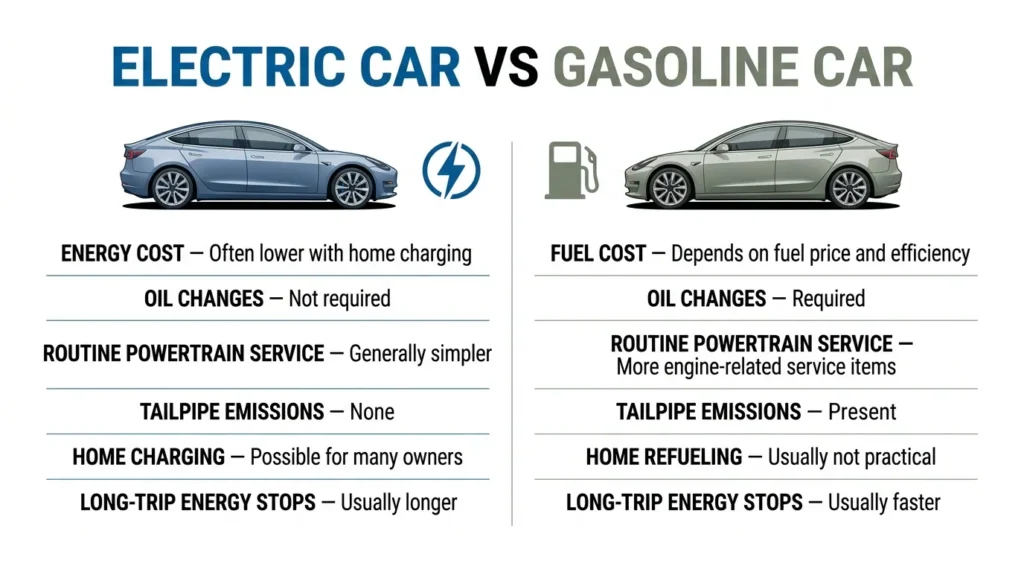
| Factor | Electric Car | Gasoline Car |
| Energy/Fuel | Often lower with home charging | Depends on fuel price and efficiency |
| Oil Changes | Not required | Required |
| Routine Powertrain Service | Generally simpler | More engine-related service items |
| Tailpipe Emissions | None | Present |
| Home Refueling/Charging | Possible for many owners | Usually not practical |
| Long-Trip Energy Stop | Usually longer | Usually faster |
| Purchase Price | Varies widely by model | Varies widely by model |
| Insurance/Depreciation | Model-specific | Model-specific |
Quick Tip: If you have reliable home charging and predictable daily driving, an EV is often easier to integrate into everyday life. If you rely entirely on public charging, compare local charging prices and locations before you buy.
Charging and Everyday Convenience
Charging is the biggest lifestyle difference between an EV and a gasoline vehicle. For many owners, the ideal routine is to charge where the car already spends time – usually at home or work – rather than waiting for the battery to become nearly empty.
Home Charging
- A standard outlet can work for drivers with low daily mileage and enough parked time.
- Level 2 charging is faster and is a common choice for overnight home charging.
- Installation cost depends on electrical capacity, wiring distance, equipment, permits, and local labor.
- Follow the vehicle manufacturer’s charging guidance rather than a universal charge-percentage rule.
Public and Fast Charging
Public Level 2 charging is useful at workplaces, hotels, shopping areas, and destinations. DC fast charging is valuable for road trips and situations where charging speed matters. Before buying, check the networks and stations along routes you actually use.
Maintenance, Battery Life, and Reliability
EVs remove many traditional engine-maintenance items, but they are not maintenance-free. Tires, suspension, brakes, climate-control systems, cooling systems where applicable, electronics, and other vehicle components still require attention.
Battery Life
EV batteries are designed for long service life. U.S. Department of Energy material has cited an expected battery lifetime of roughly 12 to 15 years under normal operating conditions in moderate climates, while actual life varies with chemistry, climate, use, charging behavior, and thermal management.
For a deeper explanation, read How Long Do Electric Car Batteries Last? (2026 Guide).
Battery Degradation Is Not the Same as Failure
A battery can gradually lose usable capacity and still function normally. EPA notes that battery replacements due to failure are uncommon in newer EVs outside major recalls. When evaluating a used EV, battery-health information, warranty status, service history, and a model-specific inspection are more useful than age alone.
Warranty
Battery warranties commonly provide long coverage periods, but the exact years, mileage limits, capacity-retention terms, exclusions, and transfer rules vary by manufacturer and model. Always read the warranty for the specific vehicle you are considering.
Environmental Impact
Battery-electric vehicles produce zero tailpipe emissions. Electricity generation still creates emissions in many regions, and battery manufacturing has an environmental footprint, so an EV is not literally emission-free over its full life cycle.
However, EPA states that lifetime greenhouse-gas emissions for an EV are typically lower than for an average gasoline vehicle, even when battery manufacturing is included. The size of the benefit depends partly on the electricity used for charging.
Battery recycling and material recovery are also developing. End-of-life batteries can contain valuable materials such as lithium, nickel, cobalt, copper, and aluminum, although recovery processes and economics vary.
Who Is an Electric Car Best For?
An EV may be a particularly good fit if you have convenient home or workplace charging, drive predictable daily routes, want lower energy and routine maintenance costs, and are comfortable planning charging on longer trips.
- You can charge reliably at home or work.
- Your normal daily driving is well within the vehicle’s real-world range.
- You want quiet, responsive driving.
- You plan to keep the vehicle long enough to benefit from operating-cost savings.
- Public fast charging is available on the longer routes you use.
When a Hybrid or Gasoline Car May Be More Practical
A hybrid or gasoline vehicle may still fit better if you cannot reliably charge, frequently travel through areas with sparse charging, regularly tow heavy loads over long distances, or place a very high value on rapid refueling during repeated long trips.
A hybrid can also be a useful middle ground for drivers who want lower fuel use without depending on charging infrastructure.
Is an Electric Car Right for Your Lifestyle?

Before buying, answer these questions using your real driving routine rather than averages:
- Where will I charge most of the time?
- How far do I drive on a normal day and on my longest regular trip?
- What will home charging installation cost, if needed?
- What are my local electricity and public-charging prices?
- How do insurance quotes compare for the exact models I am considering?
- What is the battery warranty and remaining coverage?
- Do I regularly tow, carry heavy loads, or drive in extreme weather?
- How long do I expect to keep the vehicle?
Expert Tip: Test-drive the EV and a comparable alternative, then map one or two of your real long-distance routes in the vehicle or charging-network apps. That gives you a much better picture of ownership than specifications alone.
Frequently Asked Questions
Are electric cars worth buying in 2026?
For many drivers, yes – especially those with reliable home or workplace charging and predictable daily driving. The answer depends on the purchase price, insurance, electricity cost, charging access, range needs, and how long you plan to own the vehicle.
Do electric cars really save money?
They can. EVs often have lower energy and routine maintenance costs, but total savings are not guaranteed. Purchase price, depreciation, insurance, local electricity rates, public fast-charging use, gasoline prices, and annual mileage all matter.
What are the biggest disadvantages of an electric car?
Common disadvantages include longer energy stops on road trips, uneven public-charging access, possible home-charger installation costs, range sensitivity to weather and towing, and model-specific purchase price, insurance, or depreciation concerns.
Are electric cars reliable?
EVs have fewer engine-related mechanical components, but reliability still varies by make, model, model year, software, battery system, and other vehicle hardware. Check model-specific reliability data and warranty coverage rather than assuming all EVs are equally reliable.
Is there a federal EV purchase tax credit in 2026?
For vehicles newly acquired in 2026, the former federal New Clean Vehicle Credit and Previously-Owned Clean Vehicle Credit are no longer available; the IRS says those credits ended for vehicles acquired after September 30, 2025. Other state, local, utility, manufacturer, or dealer incentives may vary.
Should I buy an EV, hybrid, or gasoline car?
Choose the powertrain that best fits your actual use. EVs are strongest when charging is convenient and daily range needs are predictable. Hybrids can work well when charging access is limited but fuel economy matters. Gasoline vehicles may remain practical for certain long-distance, remote-area, or specialized-use cases.
Final Thoughts
So, are electric cars worth it in 2026? For many U.S. drivers, they can be – but the strongest answer comes from matching the vehicle to your real routine rather than buying on technology alone.
An EV can offer low day-to-day energy costs, simpler routine powertrain maintenance, quiet performance, home-charging convenience, and zero tailpipe emissions. At the same time, charging access, purchase price, insurance, depreciation, road-trip needs, weather, and towing can materially change the ownership experience.
If you can charge conveniently and the vehicle’s real-world range comfortably covers your normal driving, an EV deserves serious consideration. If charging is difficult or your use case involves frequent remote travel or demanding towing, compare a hybrid or gasoline alternative before deciding.
Related Guides
- How Long Do Electric Car Batteries Last? (2026 Guide)
- How Much Does It Cost to Charge an Electric Car? (2026 Guide)
- How Long Does It Take to Charge an Electric Car? (2026 Guide)
- How Much Does an EV Battery Replacement Cost? (2026 Complete Guide)
- EV vs Hybrid: Which Should You Buy? (2026 Comparison Guide)