Choosing between an electric vehicle (EV) and a hybrid is less about which technology is “better” and more about which one fits your real driving routine. EVs can offer convenient home charging, lower routine powertrain maintenance, quiet performance, and zero tailpipe emissions. Standard hybrids keep gasoline refueling and can be easier for drivers who do not have reliable charging access.
The trade-offs matter. Electricity and gasoline prices vary by location, public fast charging can cost much more than home charging, purchase prices differ by model, and weather, speed, towing, and charging availability can change the ownership experience.
This 2026 comparison explains how EVs and standard hybrids work, where each one has an advantage, what to consider about purchase and running costs, and how to choose based on your own budget, travel pattern, and charging access.
Table of Contents
What Is an Electric Vehicle (EV)?
A battery-electric vehicle runs entirely on electricity stored in a rechargeable battery pack. One or more electric motors drive the wheels, and the vehicle does not use gasoline during normal operation.
EVs can be charged from a household outlet in some situations, from a Level 2 charger at home or work, or from compatible public charging equipment. DC fast charging can add energy much faster than typical home charging, but actual charging speed depends on the vehicle, charger, battery temperature, state of charge, and other conditions.
Because a battery EV has no gasoline engine, it has no tailpipe emissions and does not need engine oil changes, spark plugs, or exhaust-system service. It still needs tires, brakes, filters, wipers, fluids or coolant where specified, and other manufacturer-recommended inspections.
Main Advantages of an EV
- Zero tailpipe emissions while driving.
- Potentially lower energy cost per mile, especially with economical home charging.
- No engine oil changes and fewer engine-related routine service items.
- Quiet, responsive acceleration.
- Convenient charging at home when suitable charging access is available.
What Is a Hybrid Car?
A standard hybrid combines a gasoline engine with one or more electric motors and a relatively small battery. The vehicle automatically manages the two power sources to improve efficiency.
Most standard hybrids do not plug in. Their batteries are replenished through regenerative braking and by the vehicle’s powertrain. This is different from a plug-in hybrid electric vehicle (PHEV), which has a larger battery that can also be charged from an external power source.
A standard hybrid can be a practical choice for drivers who want better fuel economy than a comparable gasoline-only vehicle while keeping familiar gasoline refueling.
Main Advantages of a Standard Hybrid
- No routine dependence on public EV charging.
- Quick gasoline refueling for long trips.
- Improved fuel economy compared with many gasoline-only vehicles.
- A familiar ownership routine for drivers without home charging.
- Regenerative braking can reduce friction-brake use in many driving situations.
EV vs Hybrid: The Main Difference
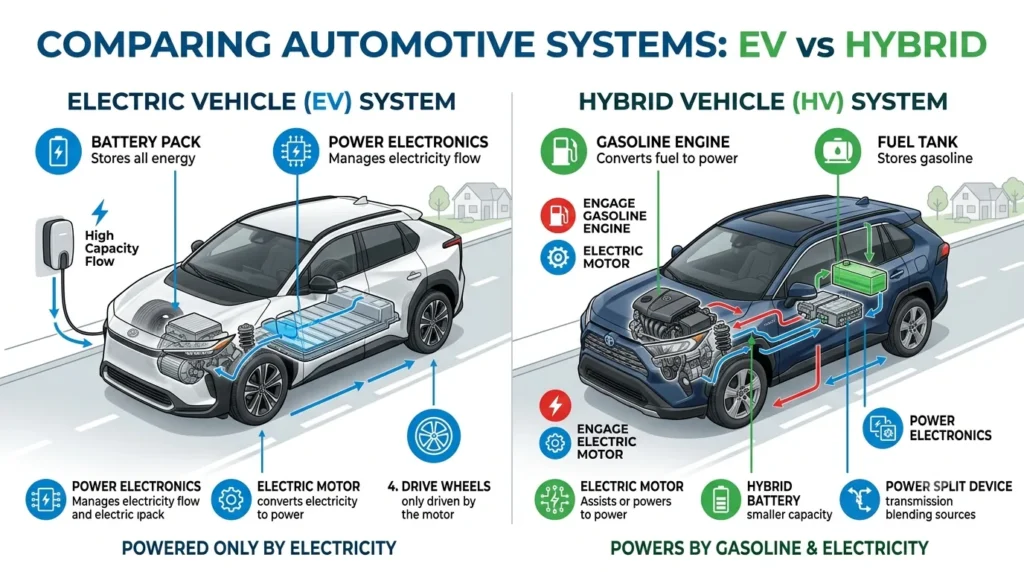
The biggest difference is the primary energy source. An EV uses electricity only and must be charged. A standard hybrid uses gasoline as well as electric assistance and normally does not need to be plugged in.
That difference affects nearly every ownership decision: where you get energy, how long an energy stop takes, which maintenance items are required, whether you can benefit from home charging, and how convenient the vehicle feels on frequent long trips.
Related Guide: For a broader EV ownership overview, see Are Electric Cars Worth It? Complete 2026 Buyer’s Guide.
EV vs Hybrid: Purchase Price and Incentives
Purchase price should be compared model by model rather than assuming every EV costs more than every hybrid. Battery size, vehicle class, trim, equipment, discounts, financing, insurance, and expected resale value can all change the result.
For U.S. shoppers, an important 2026 change is that the federal New Clean Vehicle Credit and Previously-Owned Clean Vehicle Credit are not available for vehicles acquired after September 30, 2025. Buyers should therefore avoid using older tax-credit assumptions when comparing 2026 prices.
Official source: IRS Clean Vehicle Tax Credits. State, local, utility, or manufacturer programs may differ, so check current eligibility before making a purchase decision.
A lower sticker price does not automatically mean lower total ownership cost. Compare the actual transaction price with expected energy or fuel expense, insurance, maintenance, depreciation, and your planned ownership period.
EV vs Hybrid: Energy and Fuel Costs
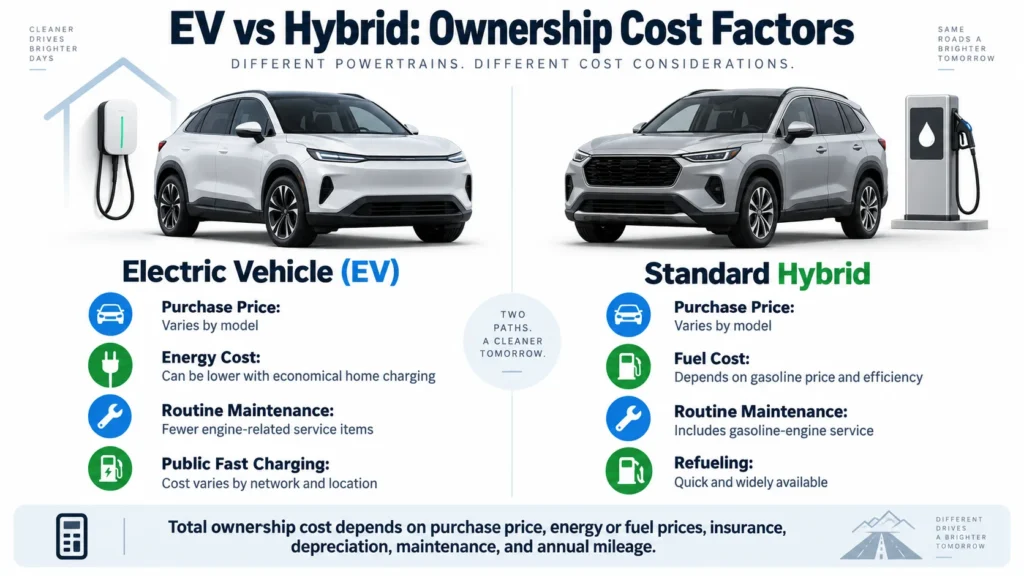
An EV can have a lower energy cost per mile when it is charged at favorable residential electricity rates. However, the advantage is not fixed. Electricity rates vary by state and utility, and frequent use of higher-priced public fast charging can narrow the gap.
A hybrid still buys gasoline, but its electric assistance can reduce fuel consumption compared with a similar gasoline-only vehicle. The actual savings depend on the model’s efficiency, gasoline price, traffic pattern, climate, and driving style.
Related Guide: For a detailed charging-cost breakdown, see How Much Does It Cost to Charge an Electric Car? (2026 Guide).
When an EV May Have the Cost Advantage
- You can charge mainly at home at a reasonable electricity rate.
- You drive enough miles for lower energy cost per mile to matter.
- You avoid relying heavily on expensive public fast charging.
- The EV’s purchase price, insurance, and depreciation are competitive for your situation.
When a Hybrid May Be Easier to Budget
- You cannot install or reliably access home or workplace charging.
- You frequently travel where public charging is limited or inconvenient.
- A comparable hybrid has a meaningfully lower purchase price.
- Fast, widely available gasoline refueling is important to your routine.
Charging an EV vs Refueling a Hybrid
Charging is one of the biggest lifestyle changes with an EV. For drivers with reliable home charging, plugging in after parking can be more convenient than making separate fuel stops. For drivers without dependable charging, the same EV can be much less convenient.
Charging time is also different from gasoline refueling. A hybrid can usually be refueled in minutes. EV charging time varies widely by charger type, vehicle capability, battery temperature, and state of charge. On a road trip, charging stops therefore require more planning than gasoline stops.
Related Guide: See How Long Does It Take to Charge an Electric Car? (2026 Guide) for Level 1, Level 2, and DC fast-charging differences.
EV vs Hybrid: Maintenance and Reliability
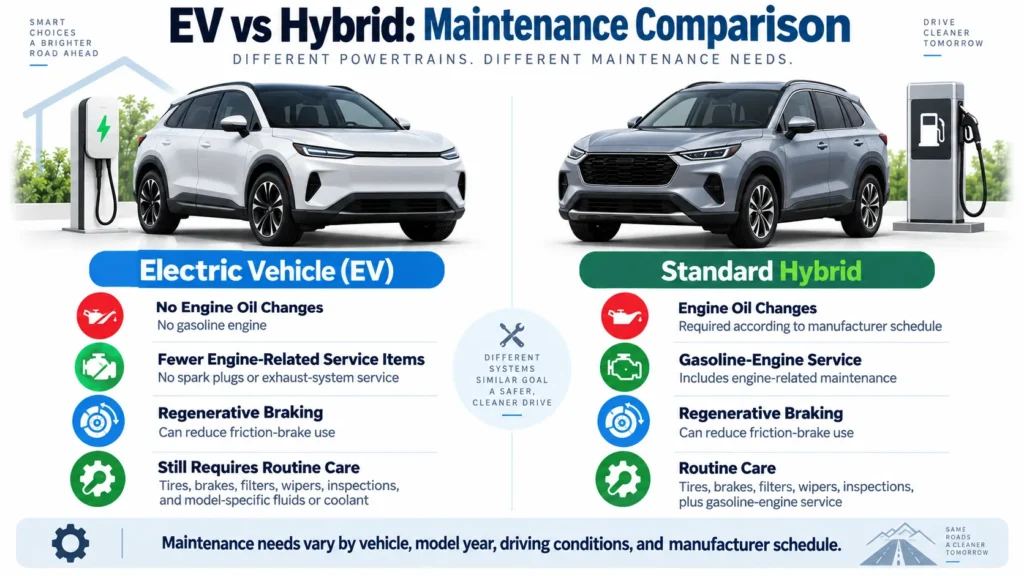
Battery EVs generally have fewer routine powertrain service items because they do not have an internal combustion engine. There are no engine oil changes, spark plugs, or exhaust-system repairs. Tires, brakes, cabin filters, wipers, suspension components, and manufacturer-specified fluids or coolant still require attention.
Standard hybrids retain a gasoline engine, so they still need engine-related maintenance such as oil changes and other services specified by the manufacturer. Regenerative braking may reduce friction-brake use, but brake inspections remain necessary.
Reliability cannot be judged by powertrain type alone. Vehicle design, battery and thermal-management systems, build quality, model history, maintenance, software, climate, and use all matter. Compare reliability information for the exact model and model year you plan to buy.
Related Guide: Battery longevity is covered in How Long Do Electric Car Batteries Last? (2026 Guide).
EV vs Hybrid: Driving Experience
EVs deliver motor torque immediately and usually accelerate smoothly without traditional gear changes. Their powertrains are quiet, although road and tire noise are still present.
Hybrids can also be smooth and quiet at low speeds, but the gasoline engine will start when the system needs it. Some drivers prefer the familiar behavior and long-trip flexibility of a hybrid, while others prefer the quieter and more responsive feel of an EV.
A test drive is valuable because accelerator response, regenerative-braking behavior, ride quality, visibility, controls, and cabin noise vary significantly by model.
Environmental Impact
Battery EVs have zero tailpipe emissions while driving. Hybrids still produce tailpipe emissions because they burn gasoline, although efficient hybrids can use less fuel than comparable gasoline-only vehicles.
Looking beyond the tailpipe, manufacturing and electricity generation also matter. The U.S. Environmental Protection Agency states that EVs typically have a smaller lifetime carbon footprint than gasoline cars even after accounting for electricity use and battery manufacturing. The exact advantage varies with the electricity mix, vehicle efficiency, battery size, mileage, and other factors.
Official source: U.S. EPA — Electric Vehicle Myths.
EV vs Hybrid: Side-by-Side Comparison
Use this table as a general decision guide. Exact costs, range, efficiency, and service needs depend on the specific vehicle.
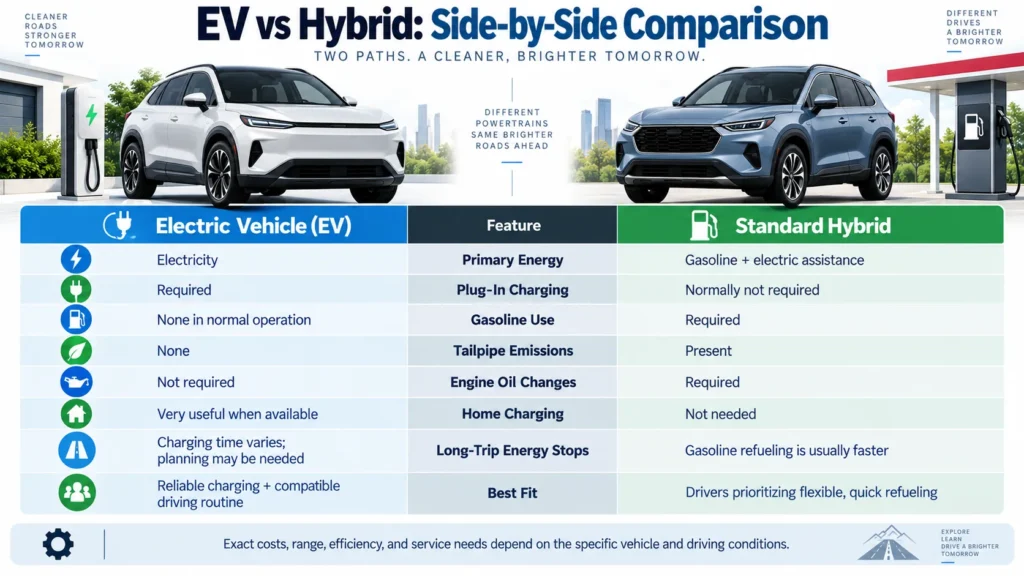
| Feature | Battery EV | Standard Hybrid |
| Primary energy | Electricity | Gasoline + electric assistance |
| Plug-in charging | Required | Normally not required |
| Gasoline use | None in normal operation | Required |
| Tailpipe emissions | None | Present |
| Engine oil changes | Not required | Required |
| Routine powertrain service | Generally fewer engine-related items | Includes gasoline-engine service |
| Home charging | Very useful when available | Not needed |
| Long-trip energy stops | Charging time varies; planning may be needed | Gasoline refueling is usually faster |
| Energy/fuel cost | Often favorable with economical home charging | Depends on fuel price and vehicle efficiency |
| Best fit | Reliable charging + compatible daily/road-trip routine | Drivers prioritizing flexible, quick refueling |
Who Is an Electric Car Best For?
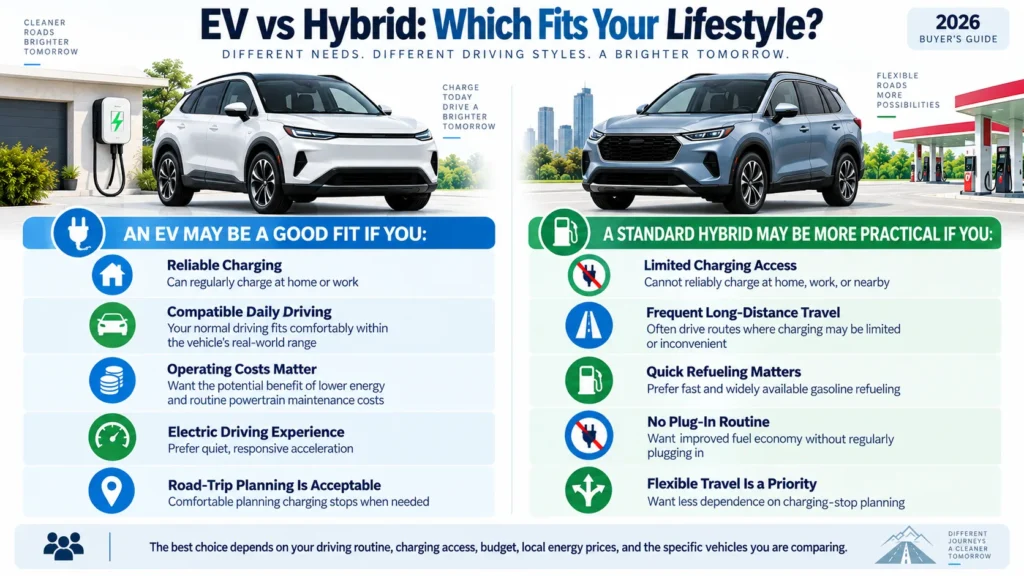
An EV may be the stronger fit when reliable charging is available and the vehicle’s real-world capability matches your routine.
- You can regularly charge at home or work.
- Your normal driving fits comfortably within the vehicle’s real-world range.
- You value potentially lower energy and routine powertrain maintenance costs.
- You prefer quiet, responsive driving.
- You are comfortable planning charging stops for longer trips when needed.
Do not choose an EV based only on an advertised range number. Consider winter or hot-weather conditions, highway speed, towing, cargo, charging availability, and how much range buffer you personally want.
When a Hybrid May Be More Practical
A standard hybrid may make more sense when charging access is uncertain or quick refueling is a high priority.
- You cannot reliably charge at home, work, or nearby.
- You frequently travel long routes where charging options are limited.
- You regularly tow or drive in conditions that make predictable charging stops difficult.
- You want improved fuel economy without changing to a plug-in routine.
- You place a high value on very quick and widely available refueling.
Frequently Asked Questions
Which is better, an EV or a hybrid?
Neither is automatically better. An EV can be a strong choice when you have reliable charging and want electric driving with fewer routine engine-related service items. A hybrid can be more practical when charging is difficult or frequent long-distance travel makes quick gasoline refueling especially valuable.
Is an EV always cheaper to own than a hybrid?
No. An EV may cost less to operate in many situations, particularly with economical home charging, but total ownership cost also includes purchase price, financing, insurance, depreciation, electricity or gasoline prices, maintenance, and your annual mileage.
Do hybrid cars need to be plugged in?
Most standard hybrids do not. They recharge their small traction battery through regenerative braking and the vehicle’s powertrain. Plug-in hybrids are different: they can also be charged from an external power source.
Which requires less routine maintenance?
Battery EVs generally have fewer engine-related routine service items because they have no gasoline engine. Hybrids still require gasoline-engine maintenance. Both types still need tires, brakes, filters, wipers, inspections, and other model-specific service.
Which is better for long-distance driving?
A hybrid is often simpler when very quick refueling and widespread fuel availability are priorities. EVs can also handle long road trips, but charging-stop planning, charger reliability, charging speed, weather, and route coverage matter.
What should I compare before buying?
Compare the exact models you are considering: transaction price, insurance quote, expected depreciation, real-world range or fuel economy, home-charging installation needs, local electricity and gasoline prices, warranty terms, cargo and towing requirements, and the charging or fuel network along your regular routes.
Final Thoughts
For a 2026 buyer, the EV-vs-hybrid decision comes down to fit. If you have dependable charging, your driving pattern works comfortably with an EV, and you value quiet electric performance and fewer routine engine-related service items, an EV deserves serious consideration.
If charging access is limited, you frequently travel long distances in areas with sparse charging, or very fast refueling is central to your routine, a standard hybrid can provide an efficient and flexible alternative.
Use your own numbers rather than broad averages. Compare the exact vehicles, your annual mileage, local electricity and gasoline prices, insurance, expected ownership period, and charging access. That approach gives you a much more useful answer than choosing by powertrain label alone.
Related Guides
- Are Electric Cars Worth It? Complete 2026 Buyer’s Guide
- How Much Does It Cost to Charge an Electric Car? (2026 Guide)
- How Long Does It Take to Charge an Electric Car? (2026 Guide)
- How Long Do Electric Car Batteries Last? (2026 Guide)
- How Much Does an EV Battery Replacement Cost? (2026 Complete Guide)