Electric vehicles (EVs) are becoming increasingly common across the United States, but new and prospective EV owners often have one important question: how long does it take to charge an electric car?
The answer depends on how and where you charge. A standard 120-volt household outlet may need many hours to replenish a large EV battery, while a powerful DC fast charger can add substantial driving range in less than an hour.
Charging time also depends on your vehicle’s battery size, its current state of charge, the charger’s power output, the EV’s maximum charging capability, and even battery temperature.
For everyday driving, many EV owners do not wait for the battery to become nearly empty. Instead, they plug in at home and replenish the energy they used during the day. On longer trips, DC fast charging can provide a much quicker top-up.
This guide explains how long it takes to charge an electric car, compares Level 1, Level 2, and DC fast charging, and covers the major factors that affect EV charging speed.
Table of Contents
What Determines EV Charging Time?
There is no single charging time that applies to every electric vehicle.
Two EVs connected to the same charging station can charge at different speeds because the vehicle and battery also determine how much power can be accepted.
- Battery capacity
- Current state of charge
- Charger type
- Charger power output
- Vehicle’s maximum AC or DC charging rate
- Battery temperature
- Weather conditions
- Battery management and thermal management systems
Battery capacity is measured in kilowatt-hours (kWh). A larger battery can store more energy, but it generally takes longer to recharge than a smaller battery when both receive the same charging power.
Charging equipment is usually rated in kilowatts (kW). In general, higher charging power can reduce charging time, but only when the vehicle is capable of accepting that power.
For example, connecting an EV that can accept a maximum DC charging rate of 150 kW to a 350 kW charger does not mean the vehicle will charge at 350 kW.
Charging speed also changes during a charging session. EV battery management systems adjust the charging rate based on factors such as state of charge and battery temperature. This is one reason charging often slows as the battery gets closer to full.
Average EV Charging Times
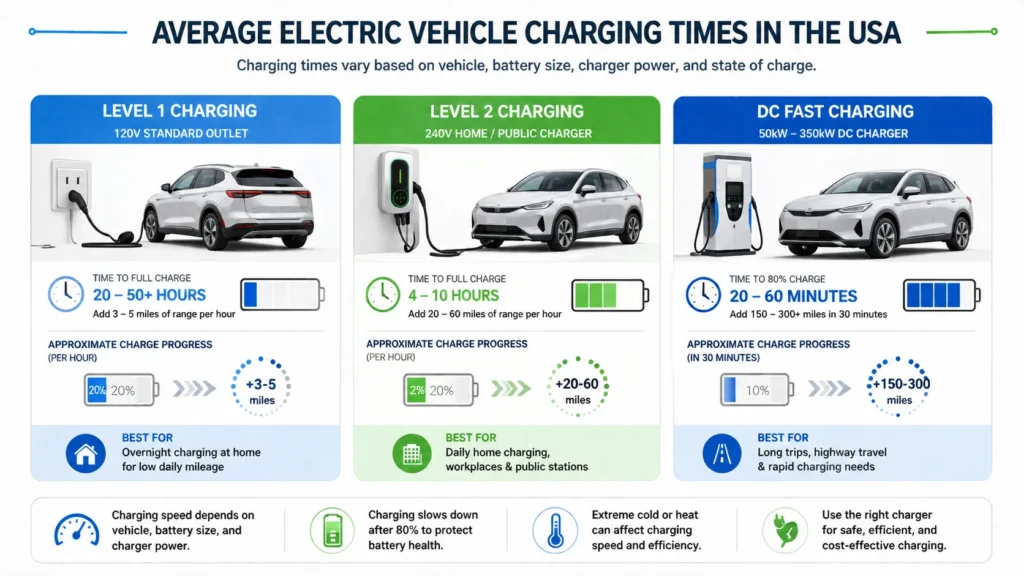
EV charging is generally divided into three categories: Level 1, Level 2, and DC fast charging.
Level 1 uses a standard 120-volt AC outlet. Level 2 generally uses 240-volt AC power in U.S. homes. DC fast charging provides much higher power directly to the vehicle’s battery and is primarily used for quick public charging.
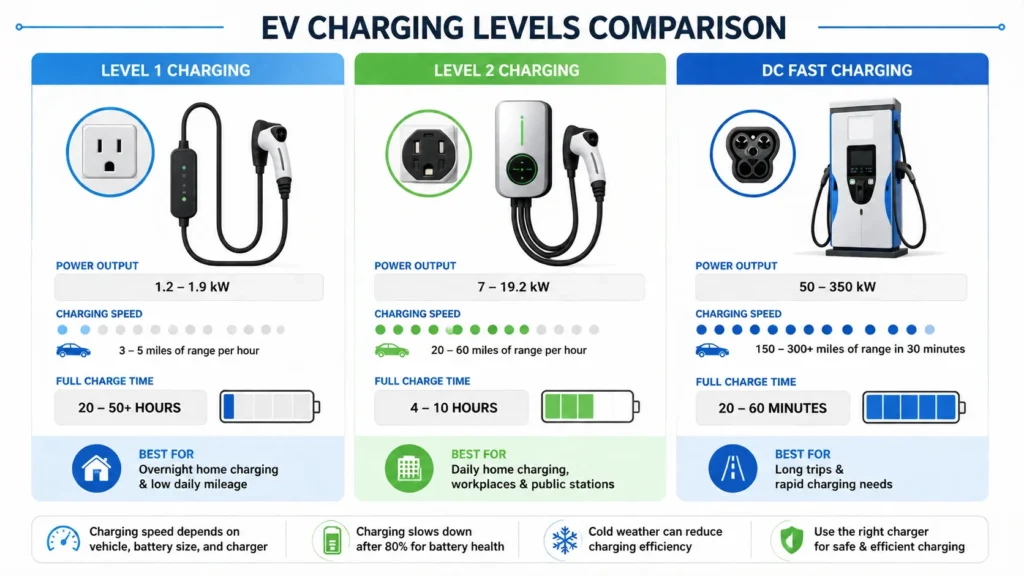
| Charger Type | Typical Charging Experience | Best For |
| Level 1 (120V) | About 3-5 miles of range per hour | Short daily driving and overnight top-ups |
| Level 2 (240V) | About 10-30+ miles of range per hour, depending on equipment and vehicle | Everyday home/workplace charging |
| DC Fast Charging | Roughly 100-200+ miles in about 30 minutes for many compatible EVs | Road trips and quick public charging |
These figures are general estimates rather than guaranteed charging speeds. Battery size, charging equipment, vehicle capability, state of charge, temperature, and other conditions can significantly affect actual results.
A completely depleted battery also takes much longer to recharge than a normal daily top-up. This distinction is important because most EV owners do not regularly charge from 0% to 100%.
For many drivers, Level 2 charging provides the most practical balance between charging speed and everyday convenience, while DC fast charging is particularly useful during longer trips.
Level 1 EV Charging
Level 1 is the slowest commonly available EV charging method in the United States.
It uses a standard 120-volt household outlet, making it accessible to drivers who have a suitable electrical outlet near their parking location.
Level 1 can be particularly useful for plug-in hybrids, EV owners with short commutes, and drivers whose vehicles remain parked for long periods.
How Fast Is Level 1 Charging?
Level 1 charging commonly adds approximately 3 to 5 miles of driving range per hour, although actual performance varies by vehicle and electrical supply.
At roughly five miles of added range per hour, an eight-hour overnight session could replenish around 40 miles of driving range.
This can be enough for someone with a relatively short daily commute.
However, fully charging a large EV battery from a very low state of charge using Level 1 may take 20 hours or considerably longer.
This is why Level 1 charging is better understood as a slow, continuous top-up rather than a quick way to refill a nearly empty large battery.
Advantages of Level 1 Charging
- Uses a standard 120-volt outlet
- May require little or no additional charging equipment
- Can work well for overnight charging
- Useful for short daily commutes
- Suitable for some plug-in hybrids
- Can be an inexpensive way to begin home charging
A driver who uses only 20 or 30 miles of range per day may find that overnight Level 1 charging replaces most or all of the energy used during normal driving.
Limitations of Level 1 Charging
The main disadvantage is speed.
Level 1 may not be practical for drivers who regularly cover long distances or need to replenish a large battery quickly.
- Slow range recovery
- Long charging times for large batteries
- Less flexibility after long trips
- May not replenish heavy daily energy use overnight
Drivers with higher daily mileage often find Level 2 charging more convenient.
Level 2 EV Charging
Level 2 is one of the most practical charging options for everyday EV ownership.
In U.S. homes, Level 2 charging generally uses a 240-volt electrical supply. It can provide substantially more power than a standard 120-volt Level 1 connection.
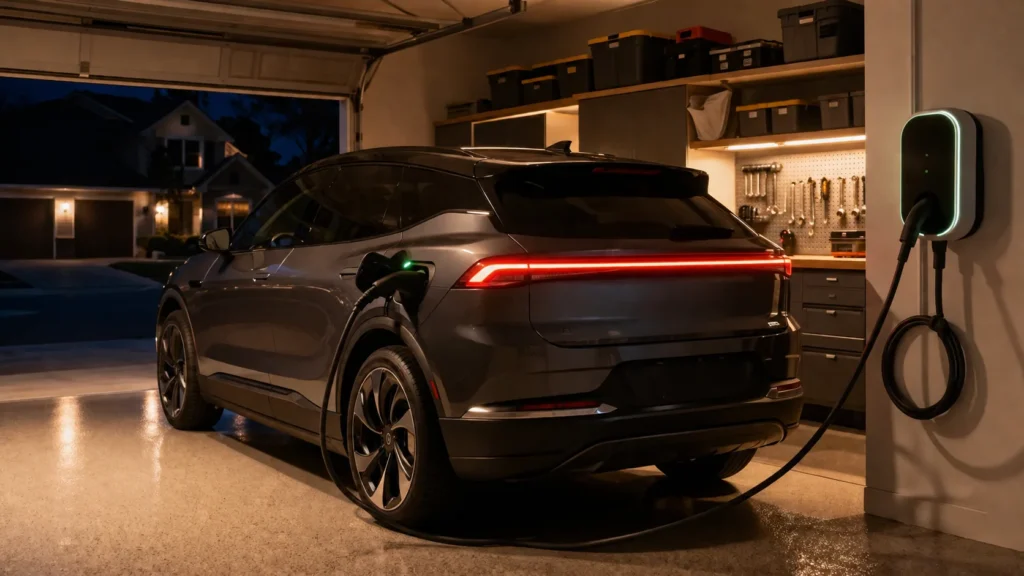
Level 2 chargers are commonly installed in homes and are also found at workplaces, hotels, parking garages, shopping centers, and other public locations.
How Fast Is Level 2 Charging?
Level 2 charging equipment can operate at different power levels. U.S. Department of Energy information shows Level 2 equipment can range approximately from 2.9 kW to 19.2 kW.
However, the vehicle’s onboard AC charger also limits the amount of power the battery can receive.
In practical terms, Level 2 charging can add roughly 10 to 30 or more miles of range per hour, depending on the charger and vehicle.
A typical overnight charging session is therefore enough to replenish a substantial amount of driving range for many EV owners.
Instead of asking how long a completely empty EV takes to reach 100%, everyday owners may find a more useful question is: Can my home charger replace the miles I drive each day before I need the vehicle again?
For many drivers using Level 2 charging, the answer is yes.
Benefits of Level 2 Charging
- Significantly faster than Level 1
- Convenient for overnight charging
- Suitable for larger EV batteries
- Practical for regular commuting
- Widely available at homes and public locations
- Can replenish substantial daily driving range while you sleep
This combination makes Level 2 a strong everyday charging solution for many EV households.
Is Level 2 Charging Worth It?
For drivers who own an EV with a larger battery, commute regularly, or frequently need to replace significant driving range overnight, Level 2 charging can be a worthwhile home upgrade.
Installation cost varies depending on the charging equipment, electrical panel, wiring, distance from the panel to the parking location, and local labor rates.
A qualified electrician should evaluate the electrical system before installing higher-powered home charging equipment.
DC Fast Charging
DC fast charging is the fastest widely available way to charge compatible electric vehicles.
Unlike Level 1 and Level 2 charging, which provide AC electricity that the vehicle converts to DC, a DC fast charger supplies DC power more directly to the battery.
This allows much higher charging rates.
DC fast chargers are primarily found at public charging locations, particularly along highways, major travel corridors, urban charging hubs, and other high-traffic areas.

How Fast Is DC Fast Charging?
Charging performance varies substantially by vehicle and charger.
Public DC fast chargers commonly advertise power levels such as 50 kW, 150 kW, 250 kW, or 350 kW, while some equipment can support still higher maximum outputs.
However, the number printed on the charger represents what the charger may be capable of providing – not necessarily what your vehicle will accept.
Many modern EVs can add a significant amount of range in approximately 20 to 30 minutes under favorable conditions.
Some vehicles may charge more quickly, while others may require considerably longer.
Manufacturers often advertise DC charging times using a range such as 10% to 80% rather than 0% to 100%. That is because fast charging generally becomes slower as the battery approaches a high state of charge.
Why Does DC Fast Charging Slow After 80%?
An EV does not normally maintain its maximum charging rate throughout the entire charging session.
The vehicle follows a charging curve controlled by its battery management system.

Charging can be relatively fast when the battery is at a lower state of charge and at an appropriate temperature. As the battery fills, the vehicle usually reduces charging power.
For this reason, charging from around 80% toward 100% on a DC fast charger can take disproportionately longer.
During road trips, stopping a fast-charge session around 80% can therefore save time when the additional range is not needed to reach the next destination.
Advantages of DC Fast Charging
- Rapid range recovery
- Shorter charging stops
- Practical long-distance EV travel
- High charging power
- Convenient charging along major travel routes
For road trips, it can dramatically reduce the amount of time required to continue a journey.
Limitations of DC Fast Charging
- Usually costs more than home charging
- Availability varies by location
- Vehicle charging capability limits maximum speed
- Charging speed can fall significantly at high battery states of charge
- Cold or very hot batteries may charge more slowly
- Charger performance and congestion can affect the experience
For drivers with home charging, Level 1 or Level 2 usually handles routine charging, while DC fast charging can be reserved primarily for trips or situations where quick charging is needed.
What Factors Affect EV Charging Time?
Charging equipment is only one part of the equation.
Several vehicle, battery, and environmental factors determine how quickly electricity can actually enter an EV battery.
Battery Size
Larger batteries contain more usable energy and generally require more time to recharge when charging power is equal.
For example, an EV with a 100 kWh battery needs substantially more energy to go from 20% to 80% than an EV with a 50 kWh battery.
However, battery size alone does not determine charging time. A larger battery paired with much faster charging capability can sometimes recharge surprisingly quickly.
State of Charge
The battery’s starting charge level has a major effect on total charging time.
Charging from 60% to 80% obviously requires less energy than charging from 10% to 80%.
The charging rate itself can also change as the battery fills. During DC fast charging, many EVs accept high power at lower states of charge before gradually reducing power as the battery approaches full.
Charging Power Output
A higher-powered charger can potentially reduce charging time, but only when the EV supports that charging rate.
If your vehicle accepts a maximum of 150 kW of DC charging power, connecting it to a charger rated at 350 kW does not automatically allow the vehicle to receive 350 kW.
The vehicle and charger negotiate a safe charging rate.
Battery Temperature
Lithium-ion batteries perform best within an appropriate temperature range.
Very cold batteries may initially accept less charging power. Excessive heat can also cause the battery management system to limit charging to protect the battery.
Some newer EVs use battery preconditioning, which can warm or cool the battery before arriving at a fast charger.
When supported by the vehicle, using navigation to route to a DC fast charger may automatically trigger this process.
Vehicle Charging Capability
Different EV models support different maximum AC and DC charging rates.
Two vehicles connected to the same 150 kW charger may therefore have very different charging times.
Battery chemistry, pack voltage, thermal management, software, and charging-curve design all influence charging performance.
Weather Conditions
Extreme temperatures can affect both driving efficiency and charging performance.
Cold weather can be particularly noticeable because the vehicle may need to use energy to warm the battery before it can accept higher charging power.
Drivers in very hot climates may also see charging power limited when additional battery cooling is required.
How to Charge an EV Faster
You cannot make an EV accept more power than it was designed for, but you can improve the charging experience by using the right equipment and planning charging sessions appropriately.
- Use Level 2 charging at home when your daily mileage makes Level 1 insufficient.
- Choose a DC fast charger that matches your EV’s charging capability on road trips.
- Use battery preconditioning before DC fast charging when your vehicle supports it.
- Avoid unnecessarily charging to 100% at every fast-charging stop when less range is sufficient.
- Arrive at a DC fast charger with a relatively low state of charge when practical and consistent with safe trip planning.
- Keep your vehicle software updated.
- Follow the charging recommendations in your vehicle owner’s manual.
Do not assume that the highest-powered charging station will always be the fastest option for your vehicle.
For example, an EV that can accept only 100 kW may gain little or no charging-speed benefit from choosing a 350 kW dispenser instead of an available 150 kW unit.
Home Charging vs. Public Charging
Home and public charging serve different purposes.
For EV owners who have access to reliable residential charging, home charging is usually the foundation of everyday EV ownership.
The vehicle can charge while parked for several hours, reducing the need to make separate fueling stops.
Public charging becomes especially valuable for longer journeys, apartment residents without dedicated charging, and drivers who need additional range away from home.
Home Charging
Home charging normally uses Level 1 or Level 2 equipment.
- Charging while you sleep
- Convenient daily top-ups
- No dedicated trip to a charging station
- Often lower electricity costs than paid public fast charging
- Ability to start many mornings with the desired battery level
Level 1 can work for lower daily mileage, while Level 2 provides much faster range recovery.
Public Charging
Public charging typically includes Level 2 and DC fast charging.
- Road trips
- Drivers without home charging
- Apartment and condo residents
- Long daily journeys
- Destination charging
- Quick range recovery while traveling
The best charging strategy depends on where you live, how far you drive, your vehicle’s charging capability, and which charging options are available along your normal routes.
Home Charging vs. Public Charging Comparison
| Feature | Home Charging | Public Charging |
| Typical Types | Level 1 and Level 2 | Level 2 and DC fast charging |
| Convenience | Excellent when home charging is available | Depends on location and charger availability |
| Speed | Slow to moderately fast | Moderate to very fast |
| Typical Use | Daily charging | Trips, destinations and quick top-ups |
| Cost | Often relatively low | Varies widely by network and location |
| Best For | Routine overnight charging | Travel and charging away from home |
For many EV owners, the most convenient approach is a combination of home charging for everyday use and public DC fast charging for longer trips.
How Long Does It Take to Charge an EV on a Road Trip?
Road-trip charging works differently from overnight home charging.
Instead of trying to reach 100% at every stop, drivers generally want enough energy to reach their next planned charging location or destination.
Because DC fast charging usually slows significantly at higher battery levels, multiple shorter charging stops can sometimes be faster than waiting for the battery to reach 100%.
- Your EV’s DC fast-charging capability
- Battery state of charge on arrival
- Charger power
- Battery temperature
- Charging curve
- Weather
- Distance to the next charger
- Charger availability
An EV with strong DC fast-charging performance and good battery preconditioning can provide a much easier long-distance experience than a vehicle with a relatively low maximum DC charging rate.
How Can You Estimate Your EV Charging Time?
A basic charging-time estimate can be made using the amount of energy needed and the effective charging power.
A simplified formula is:
Charging Time ≈ Energy Needed (kWh) ÷ Charging Power (kW)
For example, suppose an EV needs approximately 40 kWh of energy and is receiving about 7.2 kW from a Level 2 charger.
40 ÷ 7.2 = approximately 5.6 hours
Real charging time may be somewhat longer because charging is not perfectly efficient and the vehicle may change its charging rate during the session.
DC fast charging is even less suitable for a simple constant-power calculation because the charging rate can change substantially throughout the charging curve.
Frequently Asked Questions
How long does it take to charge an electric car fully?
There is no universal full-charge time. Level 1 charging can require 20 hours or more for a large or deeply depleted battery, while Level 2 can often replenish substantial range overnight. Compatible EVs using DC fast charging may add hundreds of miles of range in well under an hour, although charging from a high state of charge to 100% can take significantly longer.
How long does it take to charge an electric car at home?
It depends on whether you use Level 1 or Level 2 charging. Level 1 commonly adds around 3-5 miles of range per hour, while Level 2 can add roughly 10-30 or more miles per hour depending on the equipment and vehicle.
Can I charge an EV using a regular household outlet?
Yes. EVs can use Level 1 charging from a standard 120-volt household outlet with compatible charging equipment. However, Level 1 is relatively slow and may not be sufficient for drivers with high daily mileage.
Is Level 2 charging better than Level 1?
Neither is automatically better for everyone. Level 1 may be sufficient for short commutes and low daily mileage. Level 2 is substantially faster and is generally more convenient for drivers who regularly need to replenish more range overnight.
What is the fastest way to charge an electric car?
DC fast charging is the fastest widely available charging method for compatible EVs. Actual speed depends on both the charger’s maximum output and the vehicle’s maximum DC charging capability.
Why does EV charging slow down after 80%?
During DC fast charging, the vehicle’s battery management system generally reduces charging power as the battery approaches a high state of charge. This helps control battery conditions and means the final portion of a fast-charging session can take disproportionately longer.
Does a 350 kW charger charge every EV faster?
No. The EV must be capable of accepting that level of power. An EV with a maximum DC charging capability of 150 kW will not automatically charge at 350 kW simply because it is connected to a 350 kW charger.
Does cold weather increase EV charging time?
It can. A cold battery may accept power more slowly until it reaches an appropriate operating temperature. Some EVs use battery preconditioning to prepare the battery before arriving at a DC fast charger.
Should I charge my EV to 100% every day?
Not necessarily. The appropriate daily charge limit depends on the vehicle, battery chemistry, driving requirements, and manufacturer’s recommendations. Follow the guidance in your owner’s manual or vehicle charging settings rather than applying one percentage rule to every EV.
Is it safe to charge an electric car every night?
Modern EVs are designed to be charged regularly, and plugging in overnight is a normal routine for many owners. The vehicle’s battery management system controls charging, but owners should still follow the manufacturer’s charging recommendations and use properly installed charging equipment.
Conclusion
So, how long does it take to charge an electric car?
There is no single answer.
Level 1 charging is slow but can work well for drivers with short daily commutes. Level 2 provides much faster charging and is a practical everyday solution for many EV owners. DC fast charging provides the quickest range recovery and is particularly valuable during road trips.
Actual charging time depends on your battery size, starting state of charge, charging equipment, vehicle charging capability, battery temperature, and charging curve.
The key difference between EV charging and gasoline refueling is that EV owners often do not need to wait beside their vehicle while it charges. Home charging can take place overnight or while the car is otherwise parked.
Understanding these differences makes it easier to choose an EV and charging setup that matches your driving habits.