Buying a used electric vehicle can save money, but the high-voltage battery deserves special attention. Unlike a gasoline car, where buyers often focus on the engine and transmission, an EV’s battery pack is one of its most valuable components. Its condition can affect usable driving range, charging behavior, long-term ownership costs, and the overall value of the vehicle.
An EV battery health check helps you understand how much useful capacity the battery may still have compared with when it was new. Some checks can be done by reviewing the vehicle display, service records, warranty information, and charging behavior. Other checks may require manufacturer diagnostics or an independent EV inspection.
Battery condition should be considered alongside age, mileage, climate, charging history, and the specific vehicle model. If you want more background on long-term degradation, see our guide on how long electric car batteries last.
One important point: the range shown on the dashboard is not a battery-health certificate. Estimated range can change with temperature, driving style, recent energy use, speed, terrain, and climate-control use. A proper used-EV evaluation should look at several pieces of evidence rather than relying on one dashboard number.
Table of Contents
What Is EV Battery Health?
EV battery health describes the battery pack’s condition and its ability to store and deliver energy compared with its original capability. As lithium-ion batteries age and accumulate charge-and-discharge cycles, some gradual loss of usable capacity is normal.
Battery State of Health (SOH) Explained
State of Health, commonly written as SOH, is a way of expressing a battery’s present condition relative to its condition when new. In simple terms, an SOH estimate can help show how much of the battery’s original energy-storage capability remains. The exact calculation is not standardized across every EV, so the way SOH is reported can vary by manufacturer, diagnostic system, and third-party testing service.
The U.S. Department of Energy describes battery state of health as remaining energy-storage capacity relative to original capacity. For additional technical background, see the U.S. Department of Energy battery information.
Battery Health vs. State of Charge (SOC)
SOH and state of charge (SOC) are not the same thing. SOC tells you how full the battery is at a particular moment—similar to a fuel gauge. SOH is about the battery’s longer-term condition. A battery can be charged to 100% SOC while still having less usable capacity than it had when it was new.
Why Battery Health Matters When Buying a Used EV
A used EV with a healthy battery may still provide many years of practical service, while a vehicle with significant degradation may deliver less range than expected. Battery condition can also influence how well the vehicle fits your daily commute, charging routine, and future ownership plans.
Battery replacement can be a major expense if a problem occurs outside warranty coverage, which is why battery condition deserves attention before purchase. For cost context, read our EV battery replacement cost guide.
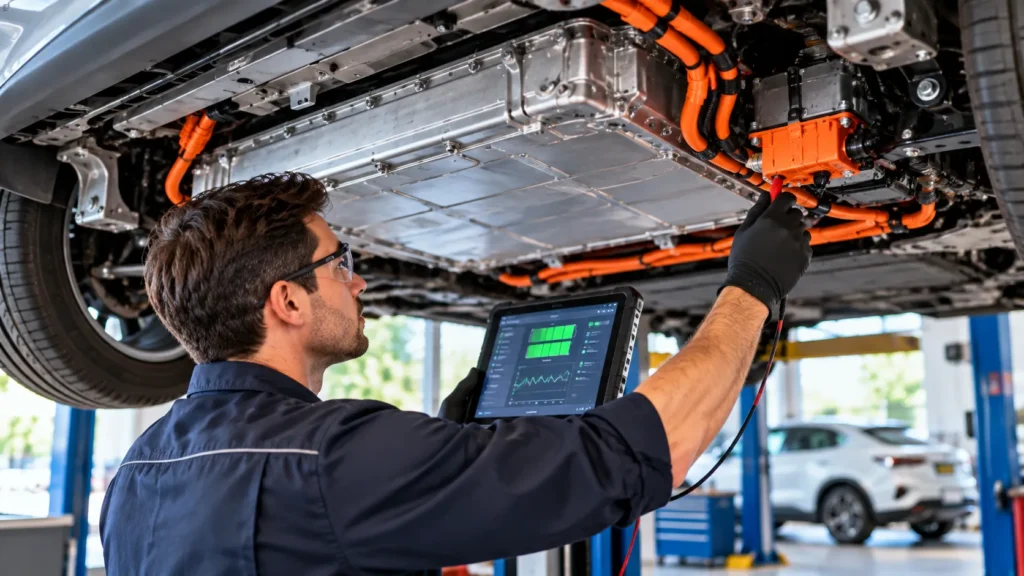
How to Check EV Battery Health: Step-by-Step
There is no single check that works exactly the same way for every electric vehicle. Battery-health displays, service menus, diagnostic tools, and available reports vary by manufacturer and model. Use the following steps together to build a clearer picture of a used EV battery’s condition.
Step 1: Check the Vehicle’s Battery Health Display
Start with the information available inside the vehicle or its official companion app. Some EVs provide battery-health information directly, while others show only charge level, estimated range, energy consumption, or charging data. Do not assume that a vehicle without a visible SOH percentage has no way to assess battery condition; model-specific diagnostics may be available through a dealer or qualified EV technician.
Step 2: Review the Estimated Driving Range
Fully charge the vehicle when practical and compare its displayed range with what is reasonable for that model, age, weather, and driving conditions. Treat this only as a screening clue. A low estimate can result from cold weather, highway driving, aggressive acceleration, heating or air-conditioning use, or recent driving history—not necessarily battery degradation.
Step 3: Ask for a Battery Health Report
Ask the seller whether a recent battery-health or diagnostic report is available. Review what the report actually measures, when it was produced, and whether it comes from the manufacturer, a dealership, or an independent testing provider. A report can add useful evidence, but no single test can guarantee the battery’s exact remaining lifespan.
Step 4: Check the Battery Warranty and Service History
Confirm the vehicle’s original in-service date, current mileage, battery-warranty terms, and any relevant service or recall work. Warranty rules differ by manufacturer and vehicle. The U.S. Department of Energy notes that many manufacturers offer EV battery warranties around eight years or 100,000 miles, but buyers should verify the exact coverage for the specific vehicle.
For broader maintenance items that should be reviewed with the battery, see our Electric Car Maintenance Guide.
Step 5: Arrange a Professional EV Battery Inspection
If the battery information is unclear, the vehicle is older, the displayed range seems unusually low, warning messages are present, or the purchase price is significant, consider a professional pre-purchase inspection. A qualified technician may be able to review diagnostic data, fault codes, charging behavior, battery-management information, and other model-specific indicators that are not visible during a basic test drive.
Part 1 ends here. Part 2 continues with: How to Test a Used Electric Car Battery Before Buying; How EV Batteries Are Professionally Tested; and What Is a Good Battery Health Percentage for a Used EV.
How to Test a Used Electric Car Battery Before Buying
A used EV battery test should combine information from the seller, the vehicle itself, and—when needed—a qualified technician. The goal is not to predict the exact day the battery will fail. Instead, you are looking for evidence that the battery’s condition, usable range, charging behavior, and warranty status are reasonable for the vehicle you are considering.
Questions to Ask the Seller
Before the test drive, ask the seller for as much battery-related history as possible. Useful questions include:
- Is a recent EV battery health check or diagnostic report available?
- Has the high-voltage battery pack or any battery module ever been repaired or replaced?
- Has the vehicle had any battery, charging-system, or thermal-management warning messages?
- Are battery-related service records and recall records available?
- What battery warranty remains, and is there documentation showing the vehicle’s original in-service date?
- How is the vehicle normally charged, and has the seller noticed a meaningful change in usable driving range?
A seller who cannot answer every question is not automatically a reason to reject the vehicle. However, missing records or unclear battery history may be a good reason to request a professional inspection before making a purchase.
What to Check During a Test Drive
Start with the battery charge level and estimated range shown on the dashboard. During the drive, watch for battery or charging warnings, unexpected power limitations, or unusual changes in the range estimate. If practical, include normal city and highway driving so you can see how the vehicle behaves under different conditions.
Remember that dashboard range is affected by temperature, speed, climate-control use, terrain, and recent driving history. It should therefore be treated as one clue rather than a direct measurement of battery State of Health.
When to Request an Independent Battery Test
An independent test becomes more valuable when the vehicle is older, has high mileage, lacks battery records, shows warning messages, or appears to have substantially less usable range than expected. It can also make sense when you are making a major used-car purchase and want more evidence before committing.
The available test depends on the make and model. A qualified EV technician may be able to read battery-management data, diagnostic trouble codes, cell or module information, and other manufacturer-specific parameters.
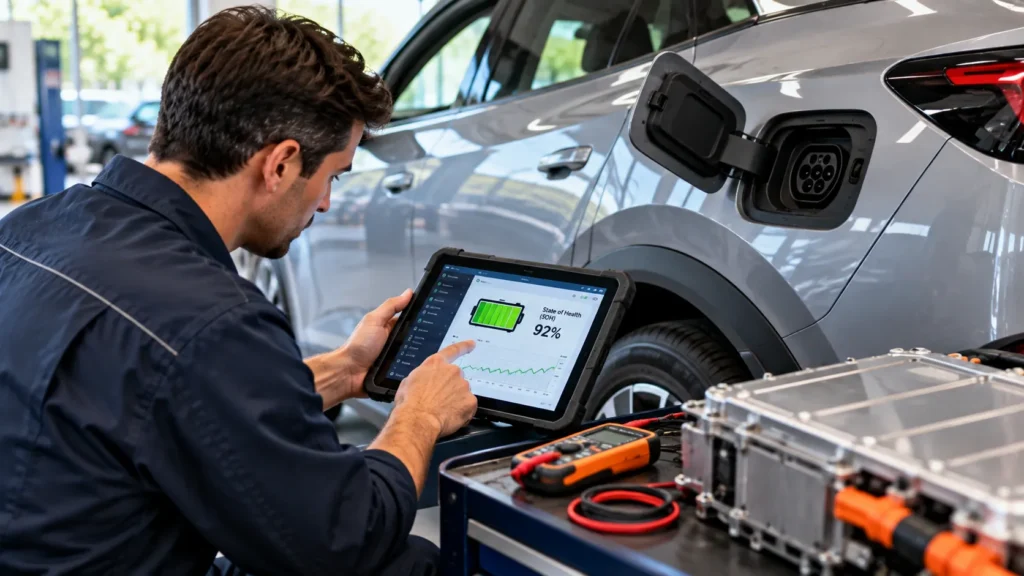
Used EV Battery Inspection Checklist
- Review any available battery-health or diagnostic report.
- Check the dashboard for battery and charging warning messages.
- Compare usable range with the vehicle’s age, conditions, and expected real-world use.
- Review battery, charging-system, and thermal-management service records.
- Confirm the battery warranty terms and remaining coverage for the specific VIN.
- Ask about previous battery or module repairs and relevant recalls.
- Observe charging behavior if a charging session can reasonably be checked.
- Request an independent EV inspection when the available information is incomplete or concerning.
How Are EV Batteries Professionally Tested?
Professional battery testing can provide information that is not visible on a normal dashboard. The exact process varies by manufacturer, model, battery-management system, and diagnostic equipment, so buyers should not expect every EV to produce the same type of report.
Manufacturer Diagnostic Tools
Dealerships and EV specialists may use manufacturer-approved diagnostic software to check battery-related fault codes and available battery data. Depending on the vehicle, this can provide a more detailed picture than the dashboard alone. The information available—and the way it is interpreted—varies by model.
Battery Management System (BMS) Data
The battery management system monitors important operating information for the high-voltage battery. Diagnostic access may reveal useful indicators related to battery condition, temperatures, charging, faults, or cell and module behavior. However, BMS data should be interpreted in the context of the specific vehicle; one number by itself does not guarantee future battery life.
Independent Battery Health Reports
Some independent services and EV specialists provide battery-health reports based on vehicle data and diagnostic methods. These reports can be useful when comparing a used EV with similar vehicles, but buyers should understand what the report measures, who produced it, and whether its methodology applies to that particular model.
No professional test can promise the battery’s exact remaining lifespan. Battery aging is influenced by factors including climate, charging patterns, battery chemistry, vehicle design, and thermal management.
For U.S. government background on EV battery life and maintenance, see the U.S. Department of Energy Alternative Fuels Data Center.

What Is a Good Battery Health Percentage for a Used EV?
There is no single battery-health percentage that makes every used EV a good or bad purchase. A State of Health reading needs context. Vehicle age, mileage, model, battery chemistry, remaining warranty, asking price, and your required daily range all matter.
How to Interpret an SOH Reading
An SOH estimate is generally intended to describe the battery’s present condition relative to when it was new. A higher reading usually indicates more of the original capacity remains, but different manufacturers and diagnostic services may calculate or report battery health differently. For that reason, avoid comparing percentages from unrelated testing systems as though they are identical.
Why Vehicle Age, Mileage, and Model Matter
Some capacity loss is expected as an EV battery ages. Climate, charging habits, battery chemistry, thermal management, and usage can also affect degradation. A battery reading that may be acceptable for an older, lower-priced vehicle could be less attractive on a newer vehicle advertised at a premium price.
If you are weighing battery condition against the broader ownership decision, our Are Electric Cars Worth It? 2026 Buyer’s Guide covers additional ownership considerations.
When a Lower SOH Reading Needs Further Investigation
A lower-than-expected SOH reading deserves closer investigation when it is accompanied by unusually limited range, battery or charging warnings, abnormal charging behavior, or unclear service history. Before deciding, verify the reading with an appropriate diagnostic method and check the manufacturer’s battery-warranty terms for that specific vehicle.
Do not treat a universal percentage—such as 70%, 80%, or 90%—as an automatic pass/fail rule for every used EV. The practical question is whether the battery’s verified condition provides enough usable range and value for your needs, while leaving an acceptable level of warranty and repair risk.

Signs a Used EV Battery May Need Further Inspection
A used electric vehicle does not need to have a perfect battery to be a practical purchase. Some capacity loss is normal as batteries age. However, certain signs justify a closer EV battery health check before you buy. These signs are clues, not automatic proof that the battery pack needs replacement.
Unexpectedly Low Driving Range
If the vehicle delivers or displays substantially less range than you reasonably expect for its model, age, weather, and driving conditions, investigate further. Range can fall because of cold or hot weather, highway speeds, terrain, climate-control use, tire pressure, and recent driving style, so one low dashboard estimate should not be treated as a battery diagnosis.
For a deeper explanation of battery aging and the factors that affect long-term capacity, see our How Long Do Electric Car Batteries Last? guide.
Battery or Charging Warning Messages
Battery-system, charging-system, or high-voltage warning messages deserve attention. Ask when the warning first appeared and whether the vehicle has been diagnosed or repaired. A qualified EV technician can check diagnostic trouble codes and determine whether the warning relates to the battery pack, charging hardware, thermal-management system, or another component.
Unusual Charging Behavior
Pay attention if the vehicle repeatedly stops charging unexpectedly, shows charging faults, or behaves differently from what the manufacturer describes for normal operation. Charging speed by itself is not a reliable battery-health measurement because it can change with battery temperature, state of charge, charger capability, and the vehicle’s charging curve.
Significant Differences Between Reported and Expected Battery Health
If a battery-health report, SOH reading, usable range, and the seller’s description do not appear to agree, do not rely on a single number. Confirm how the battery-health figure was produced and consider a second diagnostic assessment. Different manufacturers and testing services may calculate or report battery condition differently.
None of these signs automatically means the battery must be replaced. They simply indicate that you should gather more evidence before making a used-EV purchase.
[INSERT IMAGE #6 HERE – SIGNS A USED EV BATTERY NEEDS FURTHER INSPECTION]
How Much Does an EV Battery Health Check Cost?
There is no single U.S. price for an EV battery health check. Cost depends on the vehicle, the type of test, the provider, local labor rates, and whether the battery check is part of a broader pre-purchase inspection. Before booking a test, ask exactly what information the service will provide and whether the technician has experience with your specific EV model.
Free Checks Available to Owners
Start with information that may already be available at no additional cost. Depending on the model, the vehicle display or official app may show charging data, range information, warning messages, or other battery-related details. Service records, recall history, and existing diagnostic reports can also help build a picture of battery condition.
Dealership Diagnostic Tests
A manufacturer dealership may be able to run model-specific diagnostics using approved service tools. Pricing varies, so ask whether the battery test has a separate diagnostic fee or is included in a larger inspection. Also ask what the final report will show, because not every manufacturer presents battery State of Health in the same way.
Independent Pre-Purchase Inspections
Independent EV specialists may offer battery diagnostics as part of a pre-purchase inspection. The price can vary substantially depending on location, vehicle complexity, and the depth of testing. Rather than choosing a service only by price, confirm that the inspection includes the high-voltage battery and charging system and that the technician can interpret model-specific diagnostic data.
Because U.S. diagnostic and inspection prices vary widely, verify the current price directly with the dealership or inspection provider before relying on any quoted figure.
EV Battery Warranty: What Used-Car Buyers Should Check
Battery warranty coverage can materially affect the financial risk of buying a used electric car. The U.S. Department of Energy’s Alternative Fuels Data Center says many manufacturers offer EV battery warranties of about eight years or 100,000 miles, but the exact terms can differ by manufacturer, model, model year, state, and vehicle history.
Is the Original Battery Warranty Still Active?
Do not judge warranty status from the vehicle’s model year alone. Confirm the original in-service date, current mileage, and the manufacturer’s terms for the specific vehicle. If possible, use the VIN and official manufacturer or dealer records to verify remaining coverage.
Does the Warranty Transfer to the Next Owner?
A used-EV buyer should verify whether the remaining battery warranty transfers to a subsequent owner and whether any conditions apply. Transfer rules are manufacturer-specific, so check the current warranty booklet or obtain confirmation from the manufacturer or an authorized dealer before purchase.
What Battery Degradation Does the Warranty Cover?
A battery warranty does not necessarily mean that every amount of capacity loss will qualify for repair or replacement. Some warranties distinguish between defects and normal degradation, while capacity-retention provisions and measurement methods can vary. Read the battery-specific warranty language carefully, including exclusions, required maintenance or diagnostics, and any capacity threshold stated by the manufacturer.
For current U.S. government background, the Alternative Fuels Data Center’s EV maintenance and battery guidance notes that many manufacturers offer 8-year/100,000-mile EV battery warranties and recommends checking model-specific warranty information.
Warranty coverage should be considered together with battery health, vehicle condition, purchase price, and your expected ownership period. A remaining warranty can reduce some risk, but it is not a substitute for checking the battery before buying.
Used EV Battery Health Check: Final Buying Checklist
Before buying a used electric vehicle, bring the information from the battery display, diagnostic report, service history, warranty records, and test drive together. No single item should decide the purchase on its own. Use this final checklist to make sure the most important battery-related checks have been covered.
- Review any available EV battery health check or diagnostic report and note when and how it was produced.
- Check the dashboard for battery, charging, or high-voltage warning messages.
- Compare the vehicle’s usable range with its age, mileage, weather conditions, and your real-world driving needs.
- Review battery, charging-system, and thermal-management service records.
- Ask whether the battery pack or any battery module has previously been repaired or replaced.
- Confirm the original in-service date, current mileage, and remaining battery-warranty coverage.
- Verify whether the remaining battery warranty transfers to you as the next owner.
- Understand what the manufacturer’s warranty says about defects, degradation, and any capacity-retention provision.
- Arrange an independent EV inspection when the battery history is unclear, warning signs are present, or the purchase involves significant financial risk.
If the battery information is incomplete, that does not automatically make the vehicle a poor choice. It does mean you should reduce uncertainty before committing—especially when the battery is outside warranty.
Battery condition is only one part of the ownership decision. Our Are Electric Cars Worth It? Complete 2026 Buyer’s Guide covers additional costs, benefits, and practical considerations.
Frequently Asked Questions
Can I check EV battery health myself?
You can perform several useful checks yourself, including reviewing dashboard information, warning messages, estimated range, service records, warranty details, and any existing battery-health report. However, detailed battery data may require manufacturer-specific diagnostics or a qualified EV technician.
Can an EV’s displayed range tell me its battery health?
Not by itself. Displayed range is influenced by recent driving style, speed, weather, terrain, climate-control use, and battery charge level. Use range as one clue and combine it with diagnostic information, service history, and the vehicle’s overall condition.
What does SOH mean on an EV battery report?
SOH stands for State of Health. It is an estimate of the battery’s current condition relative to its condition when new. The calculation and reporting method can vary by manufacturer or testing service, so an SOH percentage should be interpreted in the context of the specific vehicle.
Should I buy a used EV without a battery health report?
A missing battery-health report does not automatically mean you should reject the vehicle, because not every model provides the same type of report. If battery condition cannot be verified through available vehicle data, service history, warranty records, and a test drive, consider a professional pre-purchase inspection before deciding.
Does fast charging always damage an EV battery?
No. Occasional DC fast charging does not automatically mean a battery is unhealthy. Battery aging depends on several factors, including temperature, charging patterns, battery chemistry, vehicle design, and thermal management. When evaluating a used EV, focus on the battery’s present condition and verified diagnostic information rather than assuming fast charging alone determines battery health.
Can a used EV battery pass a test and still develop problems later?
Yes. A battery test describes the battery’s condition at the time of testing; it cannot guarantee future performance or predict the exact remaining lifespan. That is why battery diagnostics should be considered together with service history, warranty coverage, warning signs, vehicle age, mileage, and overall condition.
Final Thoughts
An EV battery health check is one of the most useful steps you can take before buying a used electric car. Start with the vehicle’s own information, review estimated range and warning messages, ask for battery and service records, verify warranty coverage, and request professional diagnostics when the available evidence is incomplete.
Avoid treating one dashboard range estimate or one SOH percentage as a universal pass-or-fail rule. Battery condition needs to be judged in the context of the vehicle’s age, mileage, model, asking price, remaining warranty, and the range you actually need.
For more detail on long-term battery aging, read our EV battery lifespan guide.
If you are concerned about the financial risk of a battery problem outside warranty, see our EV battery replacement cost guide.
For U.S. government information on EV battery maintenance and warranties, see the U.S. Department of Energy Alternative Fuels Data Center.