Choosing an electric vehicle for a family is different from choosing an EV for one driver. Range still matters, but so do rear-seat space, cargo room, charging convenience, safety technology, price, and how easily the vehicle fits everyday routines. School runs, grocery trips, sports equipment, child seats, weekend travel, and long highway drives can quickly expose weaknesses that may not be obvious on a short test drive.
The good news is that family-focused electric cars are becoming much more practical. Several 2026 models offer around 300 miles or more of rated range, useful cargo space, modern driver-assistance features, and access to expanding fast-charging networks. Buyers can also choose from relatively affordable five-seat crossovers to large three-row electric SUVs.
This guide compares 10 of the best electric cars for families in 2026 based on the factors that matter most in real family use. Instead of choosing a single vehicle for everyone, the goal is to show where each EV is strongest, where it has compromises, and what type of family it may suit best.
Table of Contents
How We Chose the Best Electric Cars for Families
There is no single family EV that is ideal for every household. A couple with two young children may value an affordable five-seat crossover, while a family of six may need a true three-row SUV. A household that charges at home may also have very different priorities from one that depends heavily on public charging.
For that reason, the vehicles in this guide were evaluated using a balanced set of family-focused criteria:
- Passenger space and seating capacity — including whether the vehicle is better suited to five passengers or offers a genuine third row.
- Cargo practicality — room for groceries, luggage, strollers, sports gear, and other everyday family items.
- Driving range — with preference for useful highway and daily-driving flexibility rather than simply chasing the highest number.
- Charging convenience — including home charging and the ability to use practical public fast-charging options.
- Price and value — because a family EV still needs to make sense within a household budget.
- Safety and driver-assistance technology — considered as part of the overall family package, without treating electronic aids as a substitute for attentive driving.
- Everyday usability — including comfort, controls, storage, visibility, and how naturally the EV can fit normal family routines.
Range figures in this guide are EPA estimates or manufacturer-listed estimates for the specified configuration. Actual range can be lower or higher depending on speed, weather, temperature, climate-control use, load, driving habits, wheel and tire choice, and battery condition. Hyundai, for example, specifically notes that battery temperature, outside temperature, driving conditions, and vehicle condition can affect real-world range. See Hyundai’s official 2026 IONIQ 5 information.

Quick Comparison: Best Family EVs for 2026
The table below gives a quick view of the 10 vehicles covered in this guide. Prices and range can vary by trim and drivetrain, so the detailed sections explain the most important differences.
| Vehicle | Seating | Headline Range* | Family Strength |
| Hyundai IONIQ 5 | 5 | Up to 318 mi EPA | Comfort, fast-charging practicality, all-round use |
| Chevrolet Equinox EV | 5 | Up to 319 mi EPA | Value, range, cargo practicality |
| Nissan LEAF | 5 | Up to 303 mi EPA | Lower starting price, everyday commuting |
| Honda Prologue | 5 | Up to 308 mi listed | Interior space, mainstream SUV feel |
| Ford Mustang Mach-E | 5 | Up to ~320 mi EPA | Range, crossover versatility |
| Tesla Model Y | 5 | Varies by version | Cargo utility, charging access |
| Volkswagen ID.4 | 5 | Varies by trim | Comfort, conventional SUV usability |
| Kia EV9 | 6–7 | Up to 305 mi EPA | Three-row family space |
| Hyundai IONIQ 9 | 6–7 | Up to 335 mi EPA | Three rows, long-range family travel |
| Rivian R1S | Up to 7 | Varies by battery/config. | Premium space, adventure capability |
*Range is a quick-reference figure, not a guarantee. Exact EPA/manufacturer figures depend on trim, drivetrain, wheels, battery, and model configuration. The detailed vehicle sections use current official U.S. information and identify important variations.
1. Hyundai IONIQ 5 — Best All-Around Family EV Candidate
The 2026 Hyundai IONIQ 5 remains one of the most balanced electric family cars because it combines useful range, a roomy cabin, a relatively compact exterior footprint, and strong charging capability. It does not try to be a three-row SUV. Instead, it makes a strong case for families that need five seats and want an EV that works for commuting during the week and longer trips on weekends.
Hyundai lists the 2026 IONIQ 5 with a starting MSRP of $35,000. The longest-range SE, SEL, and Limited rear-wheel-drive configurations are rated at up to 318 miles of EPA-estimated range. AWD versions trade some range for additional traction and power: Hyundai lists 290 miles for SE/SEL AWD and 269 miles for Limited AWD. Official Hyundai specifications are available here.
Why It Works for Families
A family vehicle needs to feel easy to live with, not simply impressive on a specification sheet. The IONIQ 5’s long wheelbase and EV-focused packaging help create a spacious passenger area, while its hatchback-style rear opening makes loading everyday items easier than in a traditional sedan. For a family of four or five, that combination can be more useful than extra performance.
The cabin also has a flat-floor feel and a modern layout that can make movement and storage easier. Parents should still bring their own child seats to a test drive, because rear-facing seats, boosters, and the height of front occupants can change how spacious any vehicle feels in practice.
Range and Charging
For many families, the 318-mile EPA rating available on selected RWD trims is enough to reduce day-to-day range anxiety. A household with reliable home charging may start most mornings with the battery at its chosen charge limit, making school runs, work commutes, errands, and local activities straightforward.
The IONIQ 5 also benefits from a charging-focused electrical architecture designed for high-power DC fast charging under suitable conditions. For 2026, Hyundai highlights a native NACS port, which expands access to compatible Tesla Supercharger locations without requiring an adapter at supported sites. Charging speed in the real world still depends on battery temperature, state of charge, charger output, and other conditions.

Space and Everyday Practicality
The IONIQ 5 is best viewed as a spacious two-row family EV rather than a substitute for a large SUV. Families with two children, or three passengers who can comfortably share the second row, are likely to get the most value from its layout. The rear hatch is useful for grocery runs, luggage, backpacks, and routine family cargo.
Families that regularly carry six or seven people should skip directly to three-row choices such as the Kia EV9 or Hyundai IONIQ 9 later in this guide. Buying a larger vehicle only for occasional extra space can add cost and reduce efficiency, so matching the vehicle to normal use matters.
Key Compromises
- Five-seat layout means it is not suitable for households that regularly need a third row.
- AWD and some wheel/trim combinations reduce EPA-estimated range compared with the longest-range RWD versions.
- The lowest advertised starting price does not represent every configuration; family-friendly options and higher trims can increase the final price.
- Fast-charging results vary with charger capability, battery temperature, state of charge, and driving conditions.
Best for: Families of up to five who want a roomy, efficient EV with strong range and road-trip charging potential without moving to a large three-row SUV.
2. Chevrolet Equinox EV — Strong Value for Range and Family Space
The 2026 Chevrolet Equinox EV is one of the most interesting family EVs for buyers who want long rated range without immediately moving into premium pricing. Its formula is straightforward: five seats, useful cargo capacity, more than 300 miles of EPA-estimated range on both FWD and AWD versions, and a starting price that places it close to several smaller or shorter-range EVs.
Chevrolet lists the 2026 Equinox EV at a starting price of $34,995. Front-wheel-drive models are rated at up to 319 miles of EPA-estimated range, while available AWD models are listed at 307 miles. Chevrolet also lists seating for up to five and 57.2 cubic feet of maximum cargo volume. See Chevrolet’s official 2026 Equinox EV page.
Why It Works for Families
The Equinox EV’s strongest family argument is balance. A 319-mile EPA estimate gives it enough headline range for commuting and many weekend trips, while the five-seat cabin and large rear cargo area support normal family duties. Chevrolet also uses a dual-height cargo floor, which can help organize smaller items or create a more useful loading area depending on what the family is carrying.
Its pricing is also important. The starting MSRP is not the same as the final transaction price, and options can increase the cost, but the base figure makes the Equinox EV relevant to families that may have assumed a 300-mile electric SUV would require a premium-brand budget.
Range, Charging, and Road-Trip Use
The 319-mile FWD EPA estimate is especially attractive for households that want to minimize charging stops. AWD remains above 300 miles at an EPA-estimated 307 miles, according to Chevrolet. As with every EV, families should plan highway trips around realistic conditions rather than the headline number alone. Cold weather, sustained high speeds, heavy loads, elevation changes, and cabin heating or cooling can affect consumption.
For home use, overnight Level 2 charging can make EV ownership much easier for a busy household. Public DC fast charging is more important on long trips, where charger location and reliability can matter almost as much as peak charging speed. Families considering the Equinox EV should check the charging networks available on their common routes before buying.
Cargo and Passenger Practicality
Chevrolet’s listed 57.2 cubic feet of maximum cargo volume gives the Equinox EV useful flexibility when the rear seats are folded. With the seats in use, families should still test their own stroller, sports equipment, suitcases, or other bulky items before deciding. Maximum cargo figures are useful for comparison, but they do not always show how easily oddly shaped items fit through the hatch.
The five-seat layout makes the Equinox EV a natural fit for small and medium-size families. Buyers who regularly transport grandparents, additional children, or more than five occupants will be better served by a three-row EV.
Key Compromises
- It is a two-row, five-seat EV, so larger families may need a three-row model.
- Starting MSRP can rise substantially with higher trims and option packages.
- Real-world highway range can differ from the EPA estimate, especially in difficult weather or at sustained high speeds.
- Families that road-trip frequently should evaluate charging availability on their own routes, not only the vehicle’s rated range.
Best for: Families that want a practical five-seat electric SUV with strong rated range, useful cargo space, and a relatively accessible starting price.
3. Nissan LEAF — Affordable Family EV With a Major 2026 Upgrade
The Nissan LEAF has been one of the best-known names in affordable electric driving, but the 2026 model is much more than a small update. Nissan redesigned the LEAF into a crossover-style EV and gave the S+ version an EPA-estimated range of up to 303 miles. That combination makes it much more relevant to families that want a lower starting price without accepting the short driving range associated with many early EVs.
Nissan lists the 2026 LEAF S+ at a starting MSRP of $29,990, before destination and other charges. The S+ uses a 75-kWh battery and carries an EPA-estimated 303-mile range. Nissan lists the SV+ at 288 miles and the Platinum+ at 259 miles, showing why buyers should compare the exact trim rather than assuming every LEAF has the same range. See Nissan’s official 2026 LEAF specifications.
Why It Works for Families
Price is the LEAF’s strongest family argument. A starting MSRP below $30,000 gives budget-conscious EV shoppers an entry point that is lower than many electric crossovers in this guide. The new crossover body also makes the 2026 model more practical than the LEAF’s older hatchback image may suggest.
Nissan lists seating for five, 92.3 cubic feet of passenger volume without the glass roof, 20.0 cubic feet of cargo room with the rear seat up, and 55.5 cubic feet with the rear seat folded in the configuration shown in its U.S. brochure. Those figures suggest enough flexibility for groceries, school bags, luggage, and routine family use, although families with large strollers or bulky sports equipment should still test their own gear before buying.
Range and Charging
The 303-mile EPA estimate for the S+ is a major advantage for a relatively affordable EV. It gives many households enough rated range to handle several days of local driving between charges, depending on commute length and climate. The SV+ and Platinum+ trade some efficiency for additional equipment and larger wheels, so buyers who prioritize maximum range should pay close attention to trim choice.
Nissan lists a 6.5-hour 240-volt charge time for the S+ and a peak DC fast-charge time of about 35 minutes in its specifications. Those figures are useful planning references, but charging time can change with battery temperature, state of charge, charger output, and environmental conditions. Nissan also promotes Plug & Charge on compatible in-network stations and an included mobile charging cord.
Family Practicality and Technology
The S+ includes dual 12.3-inch displays and wireless Apple CarPlay and Android Auto, while higher trims add larger displays and additional convenience features. ProPILOT Assist is also listed on the S+. Driver-assistance systems can reduce workload in some situations, but they do not replace an attentive driver.
For families, the bigger question is whether the LEAF’s rear seat and cargo area fit real daily needs. A five-seat layout works well for many households with one or two children, but families that regularly carry five adults or multiple large child seats should compare it directly with roomier models before deciding.
Key Compromises
- The 303-mile EPA range applies to the S+; higher trims have lower EPA-estimated range.
- Five seats and a compact crossover footprint will not suit families that need a third row.
- The lower starting price can rise as buyers move to better-equipped trims.
- Families should verify child-seat fit and cargo needs in person because published volume figures do not show every real-world packaging limitation.
Best for: Budget-conscious families that want a modern five-seat EV with useful cargo flexibility and around 300 miles of EPA-estimated range in the S+.
4. Honda Prologue — Spacious, Comfortable Electric SUV for Five
The 2026 Honda Prologue takes a different approach from the LEAF. It is a larger two-row electric SUV with a roomy cabin, useful cargo capacity, and familiar family-SUV proportions. It can make sense for buyers who want an EV that feels closer to a conventional midsize crossover than a compact electric hatchback.
Honda lists the 2026 Prologue EX at a starting MSRP of $39,900. The EX and Touring in front-wheel-drive form carry an EPA range rating of 308 miles; available AWD versions are rated at 294 miles. The AWD-only Elite is rated at 283 miles. Honda also lists an 85-kWh battery and a maximum cargo volume of 57.7 cubic feet. See Honda’s official 2026 Prologue specifications.
Why It Works for Families
The Prologue’s appeal is straightforward: it provides the space and seating position many American families already expect from a midsize SUV, but with an electric powertrain. Its 60/40 split rear seat helps balance passenger and cargo needs, and the 57.7-cubic-foot maximum cargo figure gives families useful flexibility for luggage, shopping, sports gear, and weekend equipment.
Honda also equips the Prologue with a broad group of driver-assistance and alert features. Depending on trim, the official equipment list includes automatic emergency braking, front pedestrian braking, lane keep assist, side blind-zone alert, lane-change alert, rear cross-traffic braking, and front and rear park assist. These features can add convenience and awareness, but safe operation still depends on the driver.
Range and Charging
The 308-mile EPA rating on 2WD EX and Touring versions places the Prologue in a useful range band for family commuting and road trips. Choosing AWD reduces the rating to 294 miles, while the Elite’s larger wheels and AWD configuration are associated with a 283-mile rating. This is a good example of why trim-level details matter when comparing electric family cars.
Honda lists a DC fast-charge time of about 35 minutes from 20% to 80% state of charge under specified conditions. For Level 2 charging, Honda lists approximately 34.1 miles of range added per hour in its specifications. In practice, charging performance varies, so road-trip planning should include a buffer rather than assuming laboratory-style conditions at every stop.
Cabin, Cargo, and Everyday Use
The Prologue seats five and provides front, center-console, and second-row USB connections on listed trims, which is a small but useful detail for families carrying multiple phones and tablets. Google built-in, wireless Apple CarPlay, and wireless Android Auto are also listed, helping drivers use navigation and media without relying on a single ecosystem.
Touring adds features such as a hands-free power tailgate and panoramic moonroof, while Elite adds equipment such as ventilated front seats and a head-up display. Those upgrades may be attractive, but families focused on value should compare them against the lower price and longer range of the front-wheel-drive EX.
Key Compromises
- It remains a five-seat SUV; there is no third row for larger families.
- AWD and the Elite trim reduce rated range compared with 2WD EX and Touring versions.
- Higher trims move the Prologue well above its $39,900 starting MSRP.
- Families should compare charging availability on their regular long-distance routes before relying on any EV for frequent road trips.
Best for: Families of up to five that value a roomy, conventional SUV feel, useful cargo space, and a 300-plus-mile EPA range option.
5. Ford Mustang Mach-E — Long-Range Family Crossover With a Sportier Character
The 2026 Ford Mustang Mach-E blends family-crossover practicality with a more performance-oriented personality. That does not automatically make it the right EV for every household, but the wide range of battery and drivetrain choices lets families prioritize efficiency, all-wheel drive, or stronger performance.
Ford lists the 2026 Mustang Mach-E with a starting MSRP of $37,795. The Premium with extended-range battery and rear-wheel drive is rated at up to 320 miles EPA-estimated range. Ford lists 300 miles for extended-range eAWD, while standard-range versions are listed at 260 miles with RWD and 240 miles with eAWD. Seating capacity is five. See Ford’s official 2026 Mustang Mach-E information.
Why It Works for Families
The Mach-E gives families several ways to configure the same basic crossover. Buyers who care most about range can look toward the extended-range RWD setup, while households in areas where extra traction matters may prefer eAWD and accept some reduction in rated range. This flexibility is useful because family priorities differ by climate, commute, and travel pattern.
The five-seat cabin, hatchback-style cargo access, and crossover proportions make it suitable for daily school runs, commuting, shopping, and weekend travel. Ford also offers a large 15.5-inch center display and smartphone integration on the Select, while Premium adds comfort features such as heated and ventilated front seats.
Range, Battery Choices, and Charging
Range varies significantly by configuration. Ford lists 260 miles for a standard-range RWD version and 240 miles with standard-range eAWD. With the extended-range battery, the figures rise to 320 miles for RWD and 300 miles for eAWD. Performance-focused GT and Rally versions are rated lower, at 280 and 255 miles respectively.
For a family buyer, that means the quickest or most heavily equipped version is not necessarily the most practical choice. A 320-mile Premium RWD may be more useful for long highway trips than a higher-performance trim if maximizing distance between charging stops is the priority. Families in snowy or wet regions may value AWD more highly, even with the range tradeoff.
Technology and Family Use
The Mach-E includes connected technology that can be convenient on longer drives, and Ford offers BlueCruise on compatible vehicles and roads through its available plans. As with any hands-free or assisted-driving feature, the driver remains responsible for monitoring the road and following the system’s requirements.
Families should also consider ride comfort and wheel choice, not only acceleration. A sporty setup can be enjoyable, but parents carrying young children may place greater value on ride quality, tire replacement cost, and range. A test drive over the roads used every day is more informative than judging the vehicle only from performance figures.
Key Compromises
- It seats five, so households needing six or seven seats should look at three-row EVs.
- EPA-estimated range changes substantially with battery, drivetrain, and trim choice.
- Performance versions sacrifice some range and can cost considerably more.
- Large screens and touch-based controls may require an adjustment period for drivers who prefer traditional physical controls.
Best for: Families of up to five that want a practical electric crossover with multiple drivetrain choices and up to 320 miles of EPA-estimated range.
What These Three EVs Show About Choosing a Family Electric Car
The LEAF, Prologue, and Mustang Mach-E demonstrate why the phrase “best family EV” cannot be reduced to one specification. The LEAF emphasizes affordability and efficiency. The Prologue offers a larger, more traditional SUV experience. The Mach-E gives buyers a broader mix of range and performance configurations.
For most families, the smartest comparison starts with real needs: how many people ride in the vehicle every day, whether child seats fit comfortably, how much cargo is carried, where the vehicle will charge overnight, and how often the family takes long trips. Once those requirements are clear, range, drivetrain, trim, and optional equipment become much easier to evaluate.
6. Tesla Model Y — Strong Cargo Utility and Charging Convenience
The Tesla Model Y remains an important family-EV benchmark because it combines a relatively compact midsize-SUV footprint with useful cargo capacity, competitive driving range, and broad fast-charging access. For a household that takes frequent road trips, the charging experience can be just as important as the vehicle’s EPA range.
Tesla currently lists the standard Model Y at 321 miles of EPA-estimated range and 74 cubic feet of cargo space. The Model Y Premium is listed at 327 miles, while the longer-wheelbase Model Y L Premium is listed at 332 miles and six seats. Tesla’s lineup and pricing can change, so buyers should verify the exact configuration at the time of purchase. See Tesla’s current U.S. Model Y page.
Why It Works for Families
The Model Y’s main family strength is packaging. The rear hatch, foldable rear seating, and additional storage areas give households flexibility for groceries, luggage, school bags, and everyday equipment. Tesla lists 74 cubic feet of cargo space for the standard Model Y, although families should remember that maximum cargo figures usually assume seats are folded and do not describe every real-world loading situation.
A family of four or five can use the standard five-seat configuration without paying for a larger three-row SUV. Tesla also now lists a longer-wheelbase Model Y L Premium with six seats, giving buyers another option when occasional extra passenger capacity matters.
Range and Supercharging
Tesla lists 321 miles of EPA-estimated range for the standard Model Y and 327 miles for Model Y Premium. The company also lists 170 miles of range added in 15 minutes for the Premium under its stated conditions. Those numbers make the Model Y attractive for longer family trips, but they should not be interpreted as guaranteed real-world results.
Charging speed depends on the charger, battery temperature, state of charge, weather, and other conditions. The practical advantage is Tesla’s integrated route planning and access to its Supercharger network, which can reduce some of the planning friction associated with long-distance EV travel.
Cabin and Everyday Use
The Model Y uses a minimalist cabin centered around a large touchscreen. Some families appreciate the uncluttered design and software integration, while others may prefer vehicles with more physical controls. This is worth testing in person because a control layout that feels modern to one driver can feel distracting to another.
Rear-seat space, cargo access, and a quiet electric powertrain make the Model Y suitable for school runs and longer journeys. As with every family vehicle in this guide, parents using rear-facing child seats should bring their actual seats to a test drive rather than relying only on published dimensions.
Key Compromises
- Many vehicle functions are controlled through the touchscreen, which may not suit drivers who prefer physical buttons.
- Tesla changes configurations, pricing, and specifications more frequently than many traditional automakers, so current details should be checked before purchase.
- The standard Model Y is a five-seat vehicle; buyers needing more passenger capacity must compare the available longer-wheelbase configuration or a true three-row SUV.
- EPA range and advertised fast-charging additions are not guarantees of real-world results.
Best for: Families that value cargo flexibility, long-range capability, software integration, and convenient access to a large fast-charging network.
7. Volkswagen ID.4 — Comfortable, Conventional Family-SUV Experience
The 2026 Volkswagen ID.4 is a useful choice for families that want an electric SUV without a radically different cabin or ownership concept. Its appeal is less about headline-grabbing performance and more about comfort, everyday usability, and a familiar two-row crossover format.
Volkswagen lists the 2026 ID.4 with a starting MSRP of $45,095. The ID.4 Pro carries an EPA-estimated range of 291 miles. Volkswagen also includes a two-year Electrify America Pass+ membership with Plug&Charge and lists its IQ.DRIVE suite of driver-assistance technology as standard. See Volkswagen’s official 2026 ID.4 page.
Why It Works for Families
The ID.4’s conventional SUV proportions can make the transition to an EV easier for families coming from a gasoline crossover. It offers five-passenger seating, a rear hatch, and a flexible cargo area without asking the buyer to move into a much larger vehicle.
Volkswagen describes the ID.4 as having generous cargo capacity, and its broad rear opening is useful for common family loads. As always, published capacity should be treated as a starting point. Stroller shape, child-seat placement, sports equipment, and luggage can matter more than a single cubic-foot figure.
Range and Charging
The ID.4 Pro’s 291-mile EPA estimate is below the longest-range vehicles in this guide, but it remains practical for many households with home charging. A family driving 30 to 50 miles on a normal day may have plenty of reserve without charging every night, while longer trips require planning around public fast chargers.
Volkswagen’s included Electrify America Pass+ membership with Plug&Charge can add convenience for road trips where compatible stations are available. Families should still check station coverage on the routes they actually use, because network density and charger reliability vary by region.
Comfort, Technology, and Safety Assistance
A standard 12.9-inch touchscreen provides the main infotainment interface. Volkswagen also lists IQ.DRIVE as standard, bringing a group of safety-enhancing and driver-assistance functions. These systems can support the driver, but they do not remove the need for attention, safe following distances, or proper child-restraint use.
For buyers who prioritize a calm daily-driving experience over maximum acceleration, the ID.4 deserves consideration. A test drive should include rough pavement and highway speeds so the family can judge ride comfort, visibility, seat support, and cabin noise for itself.
Key Compromises
- The 291-mile EPA estimate for the Pro is useful but trails several 300-plus-mile options in this comparison.
- The ID.4 is a five-seat SUV and cannot replace a three-row vehicle for larger households.
- Its starting MSRP is higher than some other two-row EVs in this guide.
- Public-charging convenience depends partly on the availability and condition of compatible stations along the family’s regular routes.
Best for: Families that want a comfortable five-seat electric SUV with familiar crossover practicality and do not need the longest available range.
8. Kia EV9 — Three-Row Electric SUV for Larger Families
The Kia EV9 solves a problem that many earlier electric vehicles could not: carrying a larger family without giving up a genuinely useful third row. It is a purpose-built three-row electric SUV with six- and seven-passenger configurations, making it one of the clearest choices in this guide for households that routinely carry more than five people.
Kia lists the 2026 EV9 at a starting MSRP of $54,900 before destination and other charges. The Light Long Range RWD is rated at up to 305 miles of EPA-estimated range with its 99.8-kWh battery, while the Wind AWD is rated at 283 miles and the GT-Line AWD at 280 miles. Kia offers seating for up to seven adults. See Kia’s official 2026 EV9 information.
Why It Works for Larger Families
The EV9’s biggest advantage is simple: three usable rows. The Light RWD and Wind AWD can be configured with a second-row bench for seven-passenger seating, while selected configurations offer second-row captain’s chairs for six. That flexibility matters to families deciding between maximum passenger capacity and easier access to the third row.
Kia’s 2026 full-line information lists up to 81.7 cubic feet of cargo space behind the first row. Maximum cargo volume is not the same as luggage space with all seats occupied, but it shows the EV9’s ability to transform from a passenger carrier into a large cargo hauler when seats are folded.
Range and Fast Charging
The Light Long Range RWD is the range-focused version, with an EPA estimate of 305 miles. The standard Light RWD uses a smaller 76.1-kWh battery and is rated at 230 miles, while AWD trims trade some range for dual-motor traction and higher output. Families should therefore choose the trim around actual travel needs rather than assuming every EV9 offers 305 miles.
Kia uses an 800-volt charging architecture and lists approximately 24 minutes for a 10% to 80% DC fast charge on specified trims using a 350-kW charger under its test conditions. The 2026 EV9 also uses a NACS charging port and is compatible with Tesla Superchargers. Real charging time varies with battery temperature, charger output, state of charge, weather, and other factors.
Family Features and Everyday Practicality
The EV9’s size allows family-oriented features that smaller EVs cannot easily match. Kia lists tri-zone automatic climate control, one-touch sliding and folding second-row seats, rear-occupant alert, and multiple driver-assistance systems on the Light RWD. Higher trims add features such as surround-view monitoring, upgraded seating, and other comfort equipment.
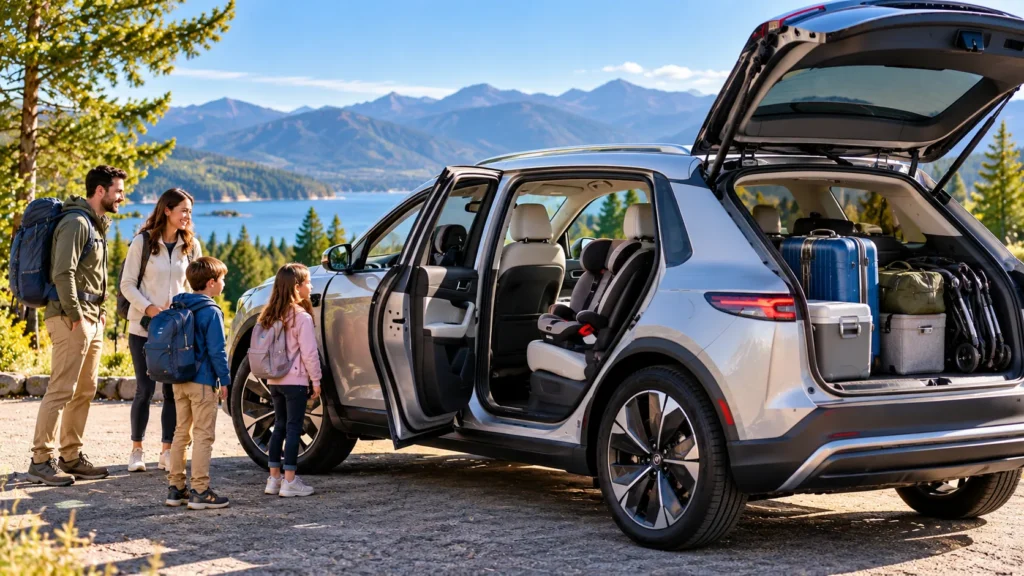
For road trips, three rows can reduce the need to squeeze children and luggage into a smaller crossover. However, buyers should examine cargo room with all three rows raised. A vehicle can have an impressive maximum cargo figure and still require a roof box or careful packing when seven people are aboard.
Price and Ownership Considerations
The EV9 is substantially more expensive than the most affordable five-seat EVs in this comparison. Kia lists the Light RWD at $54,900, Light Long Range at $57,900, Wind at $63,900, Land at $68,900, and GT-Line at $71,900 before the listed destination charge and other costs. For a family that genuinely needs three rows, the higher price may solve a real transportation requirement; for a household of four, a smaller EV may be more economical.
Large wheels, AWD, towing, heavy passenger loads, and highway speeds can also affect energy use. Kia specifically notes that actual range varies with options, driving conditions, charging practices, battery age, weather, temperature, and vehicle condition.
Key Compromises
- The $54,900 starting MSRP is much higher than several five-seat EVs in this guide.
- The 305-mile EPA estimate belongs to the Light Long Range RWD; other trims can have significantly lower range.
- Its larger exterior dimensions may be less convenient in tight urban parking spaces and small garages.
- Cargo space behind the third row is more limited than the maximum 81.7-cubic-foot figure with seats folded.
Best for: Larger families that regularly need six or seven seats and want a genuine three-row electric SUV with strong charging capability and an available 300-plus-mile EPA range.
Five Seats or Three Rows: Which Family EV Layout Makes More Sense?
The Model Y and ID.4 illustrate why a two-row EV remains the sensible choice for many households. They are easier to maneuver than a large three-row SUV, can provide substantial cargo flexibility, and avoid paying for passenger capacity that may rarely be used.
The EV9 makes the opposite case. If six or seven seats are needed every week, a true three-row vehicle can be worth the additional size and cost. Families should base this decision on normal occupancy rather than the largest group they might carry once or twice a year.
Before buying, load the vehicle as realistically as possible during a test drive. Install the child seats, sit adults in the second and third rows, open the hatch with every seat in use, and consider where charging cables, backpacks, groceries, and luggage will go. That practical test can reveal more than a specification sheet.
9. Hyundai IONIQ 9 — Long-Range Three-Row EV for Family Travel
The 2026 Hyundai IONIQ 9 is designed around a need that used to be difficult to meet with an electric vehicle: carrying six or seven people while still offering long rated range and genuinely fast charging. It is Hyundai’s first three-row electric SUV and is especially relevant to larger families that want an EV for both daily routines and long-distance travel.
Hyundai lists the 2026 IONIQ 9 at a starting MSRP of $58,955. The rear-wheel-drive S trim is EPA-rated at up to 335 miles, while SE and SEL AWD trims are rated at 320 miles and Limited and Calligraphy versions at 311 miles. The S uses a second-row bench for seven-passenger seating, while selected configurations offer six-seat layouts. See Hyundai’s official 2026 IONIQ 9 information.
Why It Works for Families
The IONIQ 9’s biggest strengths are space and flexibility. A seven-passenger configuration makes it suitable for households that regularly carry more than five people, while six-seat versions can make third-row access easier. Hyundai lists 185.44 cubic feet of total interior volume, reinforcing the vehicle’s focus on passenger comfort rather than simply adding a small emergency third row.
For families with teenagers, grandparents, or frequent passengers, third-row comfort matters more than the existence of a third-row seat on a specification sheet. Buyers should sit in every row during a test drive and check how much cargo room remains when all seats are occupied.
Range and Charging
The IONIQ 9 S stands out with an EPA-estimated 335-mile range. AWD versions give up some range but add dual-motor traction and, on higher trims, considerably more power. Hyundai lists 320 miles for SE and SEL AWD and 311 miles for Limited, Calligraphy, and Calligraphy Design trims.
Hyundai states that the IONIQ 9 can charge from 10% to 80% in approximately 24 minutes on a 350-kW, 800-volt DC fast charger using the included CCS adapter under specified conditions. With its native NACS port on a V3 Supercharger, Hyundai lists approximately 40 minutes for the same 10% to 80% window. Actual charging time varies with battery temperature, state of charge, charger output, vehicle settings, and outside temperature.
Family Practicality
A long-range three-row EV can reduce compromises for families that travel frequently. Instead of choosing between passenger capacity and useful range, the IONIQ 9 offers both in selected configurations. Its large cabin also gives parents more flexibility for child seats, older children, and adult passengers.
However, size should be considered carefully. A large three-row SUV needs more garage space and can be less convenient in crowded parking lots. Families that rarely use more than five seats may find a smaller EV easier to own and less expensive to buy.
Key Compromises
- Its $58,955 starting MSRP places it well above several five-seat EVs in this guide.
- The maximum 335-mile EPA estimate applies to the RWD S trim; AWD and higher trims are rated lower.
- A large three-row body may be unnecessary for smaller households and harder to maneuver in tight spaces.
- Ultra-fast charging figures depend on suitable high-power equipment and favorable battery and environmental conditions.
Best for: Larger families that need six or seven seats and want a three-row EV with strong rated range and high-power charging capability.
10. Rivian R1S — Premium Family EV for Space, Range, and Adventure
The Rivian R1S occupies a different part of the family-EV market. It is a premium three-row electric SUV built for buyers who want family space along with all-wheel drive, strong range options, towing and outdoor capability, and a more adventure-oriented design.
Rivian’s current U.S. configurator lists the R1S Premium from $83,990. A dual-motor configuration is shown with an EPA-estimated 329-mile range, while an available long-range dual-motor setup is listed at up to 410 miles. Rivian also offers a six-passenger captain’s-chair configuration on selected builds; other R1S configurations provide three-row family seating. Because Rivian updates configurations and model-year inventory, buyers should verify the exact vehicle before ordering. See Rivian’s current R1S configurator.
Why It Works for Families
The R1S is appealing to families that need a large SUV but do not want to give up electric driving. Its three-row layout, flexible storage, and available long-range battery configuration make it suitable for road trips, outdoor recreation, and households that carry substantial gear.
The available six-seat captain’s-chair layout can improve second-row comfort and make access to the third row easier. Families that need maximum seating should compare the exact configuration, because seating arrangements vary by build.
Range and Long-Distance Use
Rivian’s configurator shows how dramatically range can change with configuration. The current Premium dual-motor setup is listed at 329 miles EPA-estimated range, while the available long-range dual-motor option is listed at 410 miles. Wheel and tire choices, drive system, battery, weather, speed, load, and terrain can all affect real-world distance.
For a family that drives to campsites, mountains, or remote destinations, rated range is only part of the planning. Charging availability at the destination and along the return route matters as much as the vehicle’s maximum estimate. A long-range battery provides a larger buffer, but it does not eliminate the need to plan.
Space, Capability, and Cost
The R1S can carry people and gear in ways that smaller crossovers cannot, but that capability comes with a premium price. The current Premium starting figure is more than twice the starting price of some five-seat EVs covered earlier in this guide. Families should decide whether they will regularly use the extra space, capability, and range before paying for them.
Larger wheels and more performance-oriented configurations can also change efficiency, ride quality, replacement-tire cost, and range. A family-focused test drive should therefore include normal city roads and highways, not only acceleration demonstrations.
Key Compromises
- The R1S is one of the most expensive vehicles in this comparison.
- Its large exterior dimensions may be inconvenient in small garages and dense urban areas.
- Range and seating depend on the selected configuration, so headline figures do not apply to every R1S.
- Families that do not need three rows, adventure capability, or very long range may get better value from a smaller EV.
Best for: Families with a premium budget that want three-row practicality, strong range options, and capability for road trips and outdoor activities.
Best Family EVs by Use Case
The 10 vehicles in this guide solve different family needs. Rather than treating one model as the universal answer, use the following categories as a starting point for a test-drive shortlist.
- Budget-focused family: 2026 Nissan LEAF S+ — a sub-$30,000 starting MSRP with an EPA-estimated 303-mile range makes it especially relevant to value-conscious buyers.
- Range and value in a five-seat SUV: Chevrolet Equinox EV — up to 319 miles EPA-estimated range with a relatively accessible starting price.
- Balanced five-seat family use: Hyundai IONIQ 5 — roomy packaging, strong range options, and high-power charging capability.
- Traditional midsize-SUV feel: Honda Prologue — useful cargo space and a familiar two-row SUV format.
- Range plus sportier character: Ford Mustang Mach-E — multiple battery and drivetrain combinations, including an extended-range RWD configuration.
- Charging-network convenience: Tesla Model Y — strong cargo flexibility and integrated Supercharger route planning.
- Comfort-oriented crossover: Volkswagen ID.4 — a conventional five-seat SUV experience with useful range.
- Three-row value and flexibility: Kia EV9 — six- and seven-seat configurations with an available 305-mile EPA estimate.
- Three-row long-range travel: Hyundai IONIQ 9 — up to seven seats and a 335-mile EPA estimate on the S trim.
- Premium adventure family use: Rivian R1S — three-row utility with long-range configurations and outdoor capability.
What Families Should Look for Before Buying an EV
1. Choose the Right Number of Seats
Do not buy based only on the number of seats advertised. A five-seat EV may be ideal for a family of four but uncomfortable when three people regularly share the rear bench. A three-row SUV may solve that problem, but it adds cost, size, and weight. Test every seating position that your family will use.
2. Test Child Seats and Cargo Together
Child seats can change the usable space in both rows, especially rear-facing seats. Bring the actual seats to the dealership. Then check the hatch with the seats installed and ask whether the stroller, groceries, sports equipment, or vacation luggage still fits.
3. Match Range to Real Driving
A 300-mile EPA estimate does not mean every family needs a 300-mile EV, and it does not guarantee 300 miles in every condition. Daily mileage, highway speed, temperature, elevation, passenger load, climate control, and battery condition affect energy use. Build a practical reserve into road-trip planning.
4. Decide Where You Will Charge
Home charging can make EV ownership much simpler. The U.S. Department of Energy’s Alternative Fuels Data Center explains that Level 2 equipment can generally recharge a fully depleted all-electric vehicle overnight, while public DC fast charging is intended for much quicker top-ups on the road. Read the DOE/AFDC consumer charging guide.
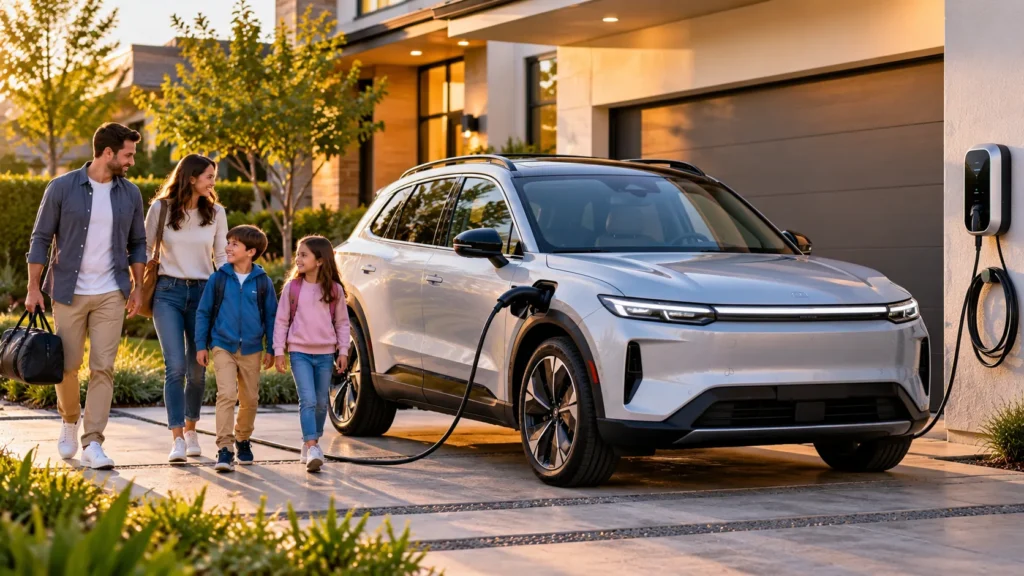
Before buying, check whether your home electrical service can support the charging setup you want and obtain a qualified installation estimate where needed. Apartment and condominium residents should confirm charging access before assuming public fast charging will be a convenient substitute.
5. Plan for Cold Weather and Road Trips
Cold temperatures can reduce EV efficiency and can also affect charging performance. The U.S. Department of Energy recommends practices such as preconditioning while the vehicle is plugged in and maintaining sufficient charge for the trip. See the Department of Energy’s winter EV guidance.
For long family trips, check charging locations before departure, identify backup stations, and avoid planning around arriving with almost no battery remaining. A charging stop can also be used for meals and rest breaks, but only when the route has reliable stations in sensible locations.

Safety and Driver-Assistance Features
Safety should be evaluated using more than the length of a vehicle’s technology list. Automatic emergency braking, blind-spot alerts, lane assistance, parking cameras, and adaptive cruise control can be useful, but availability and capability differ by trim. Driver-assistance systems also have operating limits and do not make a vehicle self-driving.
Families should review current crash-test information from recognized testing organizations, check for open safety recalls using the vehicle identification number when buying, and make sure child restraints are installed according to both the vehicle and child-seat instructions. Safety ratings can change by model year and configuration, so use current information for the exact vehicle under consideration.
Cost of Owning a Family EV
Purchase price is only one part of EV ownership. Families should compare insurance quotes, home-charger installation, electricity rates, registration fees, tire costs, financing, and expected depreciation. A more expensive EV may still fit a household budget if operating costs are favorable, but those savings should be calculated using the family’s actual mileage and local electricity prices.
Electric vehicles eliminate some gasoline-vehicle maintenance items such as engine oil changes, but they still need tires, brakes, suspension service, cabin filters, coolant or other scheduled checks where specified, and normal wear-item replacement. Heavier vehicles and high torque can also make tire choice and driving style important to long-term costs.
Expert Tips for Choosing the Best Electric Cars for Families
Pro Tip 1: Test the EV with your real family setup.
Do not judge cabin space from specifications alone. Bring your child seats, sit family members in their usual positions, and check front-seat comfort after installing a rear-facing child seat. Also test whether your stroller, school bags, or regular luggage fits without constantly folding the rear seats.
Pro Tip 2: Compare the exact trim—not just the model.
Range can change significantly between trims because of battery size, AWD, wheels, tires, and equipment. A model advertised with more than 300 miles of range may have other versions rated considerably lower. Always check the EPA rating for the exact configuration you plan to buy. If driving range is a priority for your family, see our guide on how to maximize the range of an electric car for practical ways to get more miles from your EV.
Pro Tip 3: Check home charging before signing the deal.
Find out where the EV will charge, what electrical service is available, and what a Level 2 installation would cost before buying the vehicle. DOE notes that many drivers charge overnight at home and that Level 2 charging can generally recharge a fully depleted EV overnight. Alternative Fuels Data Center
Pro Tip 4: Plan around your worst regular trip, not your average commute.
A short daily commute may make almost any modern EV look suitable. Instead, consider the longest trip your family makes regularly—such as visiting relatives, weekend travel, or an airport run—and check fast chargers on that route. Keep a reasonable range buffer rather than planning to arrive nearly empty.
Pro Tip 5: For cold-weather travel, use preconditioning when available.
Cold temperatures can affect EV range and charging. The U.S. Department of Energy recommends warming the cabin and battery before driving, preferably while the vehicle is still plugged in. The Department of Energy’s Energy.gov
Pro Tip 6: Check recalls using the VIN—not only the model name.
Before buying, especially if the vehicle is used or dealer inventory has been sitting for some time, check the specific VIN for open safety recalls. NHTSA’s VIN lookup identifies unrepaired recalls, and NHTSA recommends checking recalls at least twice a year after purchase as well. NHTSA
Pro Tip 7: Get an insurance quote before choosing the final EV.
Two similarly priced EVs can have different insurance costs. Give your insurer the exact year, model, and trim before purchase so the premium becomes part of your ownership-cost comparison.
Pro Tip 8: Do not pay for a third row you rarely use.
A three-row EV is valuable when six or seven seats are regularly needed. For a family that normally carries four people, a smaller two-row EV may cost less, fit the garage more easily, use less energy, and still provide enough cargo space.
Family EV Buying Checklist
- Confirm the number of seats your household needs every week, not just occasionally.
- Install your child seats during the test drive and check front-seat comfort at the same time.
- Load a stroller or measure the cargo items you carry most often.
- Compare EPA range for the exact trim, drivetrain, battery, and wheel configuration.
- Check home-charging installation cost and electrical capacity before purchase.
- Map the public fast chargers on your most common long-distance routes.
- Compare insurance quotes for the exact EV before signing the purchase agreement.
- Review warranty coverage, including the high-voltage battery warranty.
- Check current safety ratings and recalls for the exact model year.
- Test infotainment, climate controls, visibility, parking cameras, and driver-assistance features yourself.
- Consider winter range and charging if you live or travel in a cold climate.
- Compare total purchase price after destination charges, options, taxes, and fees rather than relying only on advertised starting MSRP.
Frequently Asked Questions About Family Electric Cars
What is the best electric car for a family?
There is no single EV that fits every family. A five-seat household may prefer the value of the Nissan LEAF or Chevrolet Equinox EV, while a larger family may need the three-row Kia EV9 or Hyundai IONIQ 9. The right choice depends on seating, cargo needs, budget, charging access, and typical trip length.
What is a good electric SUV for a family of five?
Several two-row EVs in this guide are designed around five-passenger use, including the Hyundai IONIQ 5, Chevrolet Equinox EV, Honda Prologue, Ford Mustang Mach-E, Tesla Model Y, and Volkswagen ID.4. Compare rear-seat space, child-seat fit, cargo room, range, and price rather than choosing on range alone.
Are there electric cars for families of six or seven?
Yes. The Kia EV9 and Hyundai IONIQ 9 offer six- or seven-passenger configurations, while the Rivian R1S also provides three-row family seating depending on configuration. Tesla also lists a six-seat Model Y L Premium. Verify the exact seating layout before ordering.
Is 300 miles of EV range enough for a family?
For many households, 300 miles of EPA-estimated range provides substantial flexibility, especially when the vehicle can charge at home. Families that take frequent long trips should also consider charging speed and station availability. Actual range can fall below the EPA estimate in cold weather, at high highway speeds, or with heavy loads.
Do families need a Level 2 home charger?
Not every household needs one, but Level 2 charging is often the most convenient home solution for an all-electric vehicle because it can add substantially more range per hour than a standard 120-volt outlet. The right setup depends on daily mileage, the vehicle, parking location, electrical capacity, and local installation requirements.
Are electric cars practical for family road trips?
They can be, particularly when the EV combines useful highway range with reliable fast-charging access. The trip may require more planning than a gasoline vehicle, especially in areas with fewer chargers. Families should plan charging stops, keep backup locations in mind, and allow extra time in difficult weather.
Final Thoughts
The best electric cars for families in 2026 are no longer limited to small commuter vehicles. Buyers can choose affordable five-seat EVs, long-range crossovers, and genuine three-row electric SUVs. That variety makes it easier to match an EV to a household instead of forcing the household to adapt to the car.
For smaller families, models such as the Hyundai IONIQ 5, Chevrolet Equinox EV, Nissan LEAF, Honda Prologue, Ford Mustang Mach-E, Tesla Model Y, and Volkswagen ID.4 offer different combinations of price, range, comfort, cargo flexibility, and charging. Larger households can look toward the Kia EV9, Hyundai IONIQ 9, and Rivian R1S for additional seating and space.
The final decision should come after a realistic test drive. Install the child seats, load the cargo area, sit in every row, check home-charging costs, and map the chargers on routes your family actually drives. Specifications help narrow the list, but everyday usability is what determines whether an electric car truly works for your family.